The Bell That Cost a Ferry Landing
Page 57 of 284
Chapters
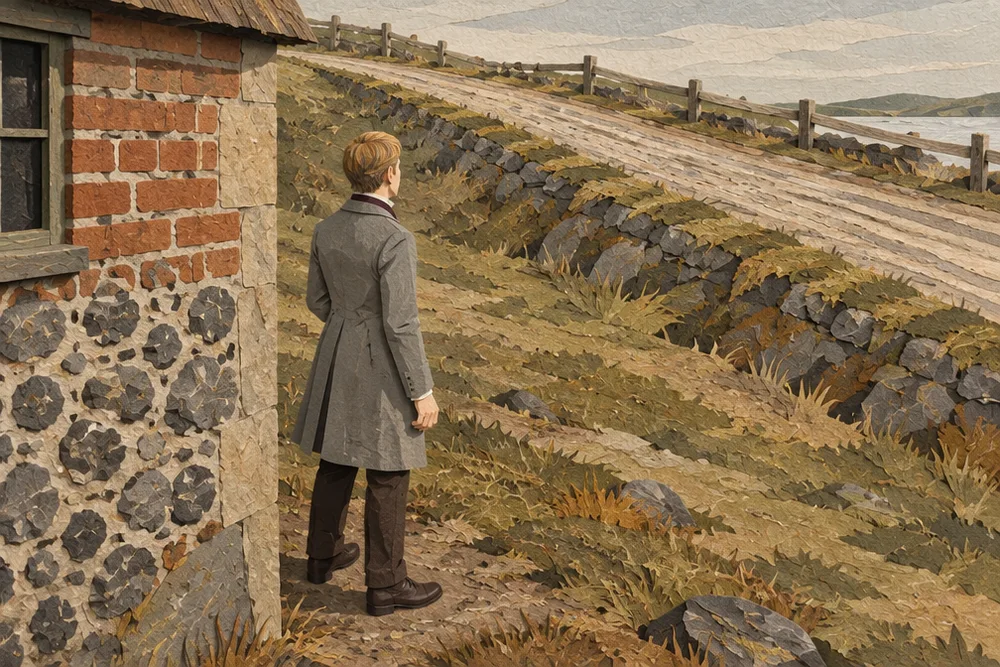
They did not widen the hole. Peregrine had learned, in the first years of his work, that a man with a spade could destroy evidence faster than a man with a pen could record it. Instead he measured the joint’s line and took a bearing from the cottage corner to the ferry road. The alignment crossed the bank at an angle, not toward the open fields as he had expected, but toward the lower end of Rosamund Trennick’s landing. The bearing could be wrong by several degrees; the old boundary stones were not where the parish plan put them. Still, the mark on his paper fell close to the landing’s inland edge.
“That’s under Miss Trennick’s steps,” Kit said. “Or near them.” He had seen the landing built board by board and knew which planks sat above the old stones. “She said the bottom step bubbles when the tide turns.” Peregrine looked up. He had heard Rosamund’s account and had called the sound a consequence of trapped mud, a plausible explanation when the old bell beneath the landing had given one note through the earth. He had dismissed the bell as scrap—an object abandoned when the stairs shifted—and the bubbles as disturbed sediment. It was possible he had been right in each particular and wrong in their combination.
He asked Kit whether he had seen water pass through the joint. Kit shook his head. “Not through it. Only the wet mark.” This distinction mattered. The ebb reversal and the bell’s note were signs, not proof of a continuous outlet. Peregrine wrote that too. The boy’s answer made him trust the boy more, not less. He checked the bearing again and found the same alignment within the width of his pencil stroke. The channel, if it existed, ran beneath the bank toward the landing. What lay on the river side remained unseen.
Nell came along the path carrying a laundry basket against her hip. The basket was empty, but its wicker rim was dark with damp. She stopped to examine the patch they had cleared. “That wall was here when my mother had the cottage,” she said. “She used to call it the old sluice end. Nobody could tell us where it went.” Peregrine asked whether her mother had seen it open. Nell shook her head. “Not that I remember. My mother said the water went under the road. Then the road was raised, and folk began saying the channel was dead.”