The Bell That Cost a Ferry Landing
Page 2 of 284
Chapters
Thirty years ago, before the river shifted its course and ate the old ferry stairs, the landing bell had hung from an oak frame to warn passengers when fog shut the far shore from view. Rosamund remembered it only from her mother’s stories and from one glimpse of the bronze in a cart of salvage. Her mother had bought it cheap after the stairs were abandoned. It had been too heavy to carry to the new crossing, too cracked to trust for a signal, and too useful to throw away. So they had set it in the stone culvert beneath the bank, where its loose clapper served as a flap counterweight.
Her mother called it a clever use for a useless thing. Rosamund had thought the culvert was a dead drain. The commissioners’ new embankment was to close every uncharted passage beneath the bank; the surveyor’s drawing showed clean earth from river to field. If that passage still carried water, no one had told her. If the bell had sounded, something had moved it.
She took the short-handled mallet from the tool basket and tapped twice on the landing. The note was a hard, dry knock, nothing like the buried sound. She tapped again nearer the shoreward end. A nail head jumped in its countersink. She marked the board with a thumb of chalk.
Peregrine Cleeve arrived before the tide had turned. He came along the embankment with a leather roll of drawings under one arm and a pair of field glasses dangling at his chest. Tall and narrow-hipped, he moved as if he had been folded carefully and did not wish to crease himself. His dove-coloured frock coat had mud on one cuff. His chin stayed tucked as he looked over the new work.
“Miss Trennick,” he said. “I heard the commotion.”
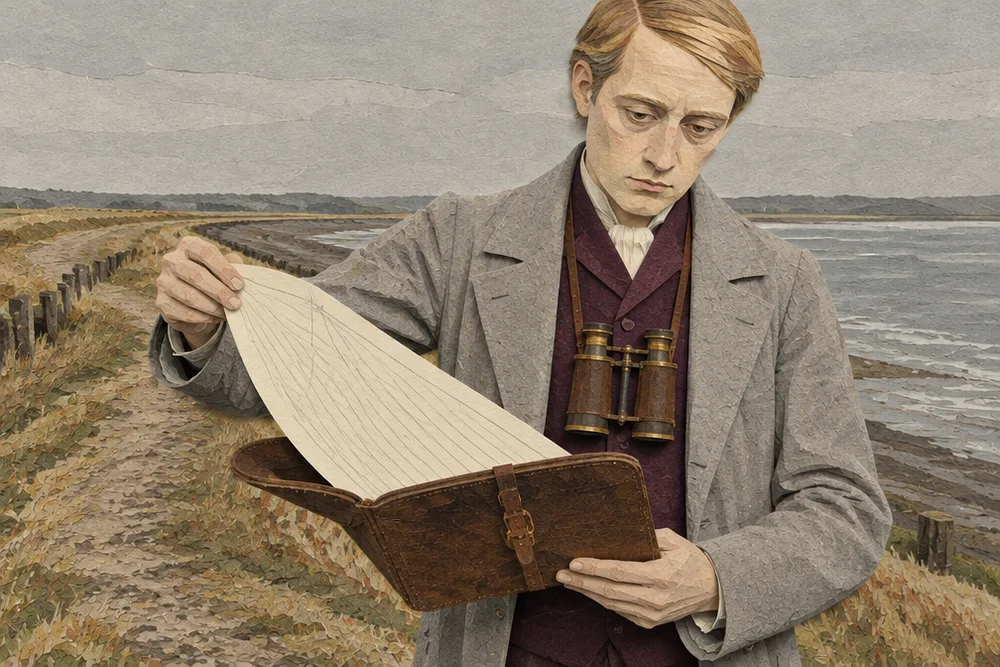
“The old bell sounded.”
He glanced at the landing. His hooded eyes were difficult to read, but his mouth tightened as if she had presented him with an inconvenience rather than a fact. “There is no bell in the survey.”
“There is one beneath the bank.”
“There was one,” he said. He opened the drawing case and withdrew a sheet. Its ruled lines crossed the reach and bank with the composure of a thing that had never been wet. “The old culvert is silted. The bronze was entered as scrap when the stairs went. I have taken no account of it.”
“Then your account is wrong.”