The Bell That Cost a Ferry Landing
Page 129 of 284
Chapters
“I shall not.”
“And do not confuse your uncertainty with permission to delay the embankment.”
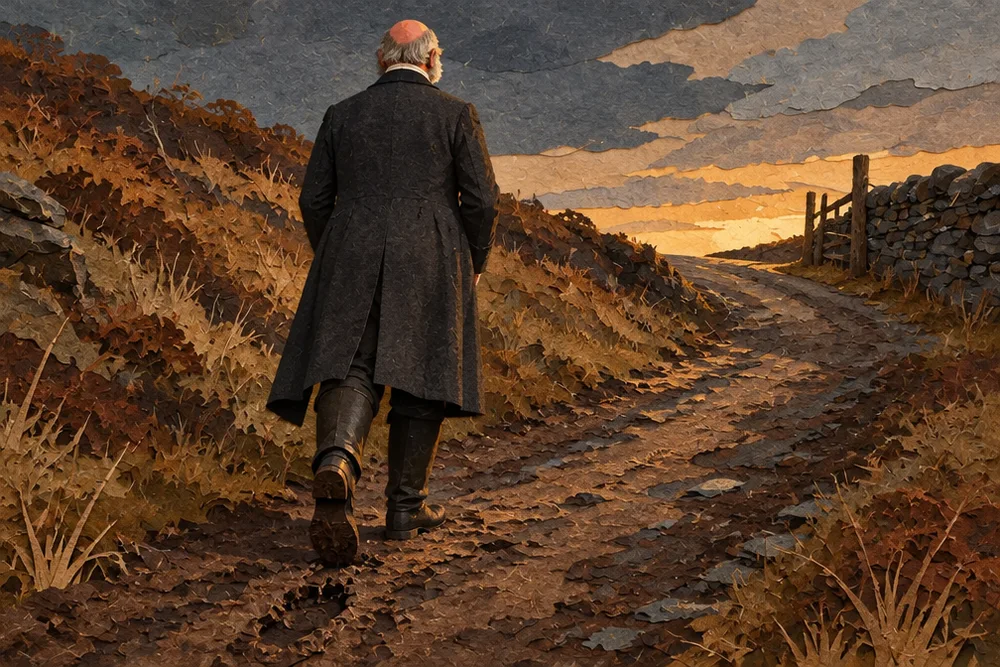
Peregrine stopped. In the dusk, Varneck’s face was mostly angles: the triangular jaw, the white sweep of his muttonchops, the bald crown reflecting a little remaining light. “If the embankment closes a passage that drains these houses, the question is not whether we may delay. It is whether we may close it at all.”
“That is for the board.”
“Then the board must be given enough to decide.”
Varneck resumed walking. “You have written what you can defend.”
Peregrine watched him go toward the road, where the clerk’s lantern swung ahead. He did not call after him. He understood the commission’s position: the upstream farms had been drowned by poor drainage; the levy had been argued over for years; the bank was meant to hold. A hidden outlet could compromise the whole plan. But a bank that held river water while trapping the cottages’ water would not be a sound work. The neat line could not settle which duty mattered more.
At Nell’s door, she had moved the basket and tub to a dry shelf. Kit stood by the ditch with a lantern, facing downstream. Nell herself had a second lamp inside, its glow spilling onto the floor. Peregrine could see the chalk mark on the stone, now cleanly above the receding water.
“The men will watch,” he said.
“I heard.” Nell’s broad lips were set. “They’ll be here all night?”
“They are paid for the night.”
“And tomorrow?”
He hesitated. “Tomorrow I will submit the report.”
“That is not what I asked.”
“No,” he said. “It isn’t.”
Nell looked past him toward the embankment. “You found nothing beneath it.”
“We found that the ditch rose when the outlet was blocked and fell when it was opened.”
“You found the water.” She gave her own lamp to Kit, who took it with both hands. “You didn’t find where it went.”
“No.”
“Then keep looking.” She stepped inside and closed the door, not sharply, but with finality. The latch clicked home.
Peregrine remained on the path until the cottage windows glowed against the dusk. The men’s lantern stood by the ditch, casting a flat fan of light over the mud. Water continued to ease away from the chalked marks. The torn canvas lay dark beside the grille, a discarded object that had briefly turned the hidden arrangement into a visible one.