The Bell That Cost a Ferry Landing
Page 122 of 284
Chapters
There was sense in that, though he did not like how neatly the phrase fitted the day’s work. Peregrine returned to the bank. He had been taught to distrust the confident local account, especially when the local account stood to gain from a particular result. Rosamund Trennick wanted a ferry lease. Nell wanted the drain left open. Varneck wanted the embankment completed. Each had a claim; none could supply a neutral measure by wanting it.
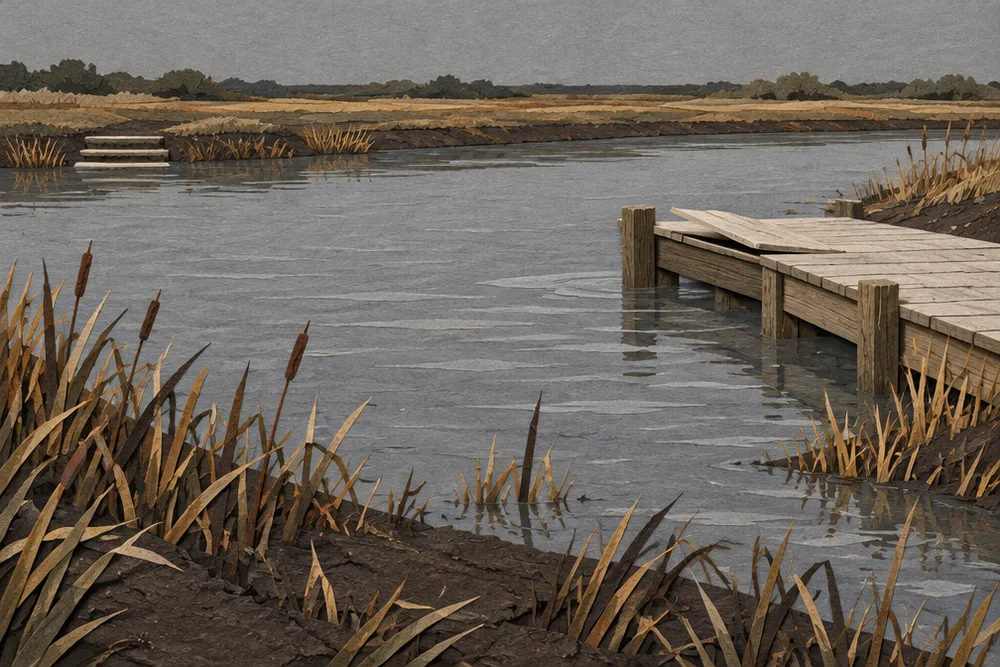
The tide’s crest passed without spectacle. The river did not rise in a wall; it pressed, sheet by sheet, into the lower reeds and around the abandoned ferry stairs upstream. The old steps showed only their upper edges. At Rosamund Trennick’s new landing, a few planks lifted and settled with the water. Peregrine could see the place from the bank, its pale timber bright against the peat-dark mud. The landing had cost her savings. It also sat above the buried passage he had omitted from his drawing.
“The landing should be taken up,” Varneck said, following his gaze. “If the bank is to be closed, we cannot leave a structure over the works.”
“We have not proved the works lie beneath it.”
“You heard the bell.”
Peregrine’s attention returned to the chair. “A sound is not a survey.”
“Nor is it nothing.” Varneck leaned lightly on his stick. “The woman may have heard metal shifting in the mud. It does not make a channel.”
“No.” Peregrine looked at the landing again. “It does not.” The note had come through the mud during the rising tide, so Rosamund said. A bell’s loose clapper might sound if moved by water. That made a passage plausible, not certain. He had been trained to keep those two propositions apart. Yet the drawing’s blank ground made them difficult to ignore.
The clerk reported the next measurements. The ditch had risen slightly by the cottage and scarcely at all near the plug. Peregrine checked the figures himself. The difference could be error. It could also mean the water was gathering below the embankment, or being fed from the other direction. He asked for another reading in half an hour.
Varneck frowned. “If we wait for every fluctuation, we shall have no result before dark.”
“If we ignore the fluctuation, we shall have a result whether it is true or not.”
The chair’s small hands tightened on the stick. For a breath, Peregrine expected a rebuke. Instead Varneck looked toward the cottages. A thin wet track had appeared beneath the open door of Nell’s house. It might have been water carried in on a pail or seeping through the threshold. Nell noticed him looking and came out again, this time with a shallow wooden tub held against her hip.