The Bell That Cost a Ferry Landing
Page 120 of 284
Chapters
Nell’s gaze settled on Varneck’s boots. They were polished black, high at the ankle, and scarcely marked by the walk from the road. “Then you’d best stand where it climbs,” she said.
The chair’s expression did not change. “I have no objection to observing the test.”
“You have the boots for it.”
Peregrine looked down at the mud around his own shoes. Nell was not making a joke. Her voice had the clipped certainty of someone accustomed to knowing exactly which pail leaked and which floorboard sagged. He opened his mouth to answer for Varneck, then stopped. He had no authority to promise that the chair would stand in water, and no wish to make another tidy assurance on behalf of a man who had not yet been wet.
Nell turned away and went back toward her cottage. The door remained open. A strip of white linen hung over the garden hedge, stirring in the river air. Peregrine noticed that the cloth’s lower edge was already damp, though no rain had fallen. He made a note of it, though the clerk’s paper had no column for laundry.
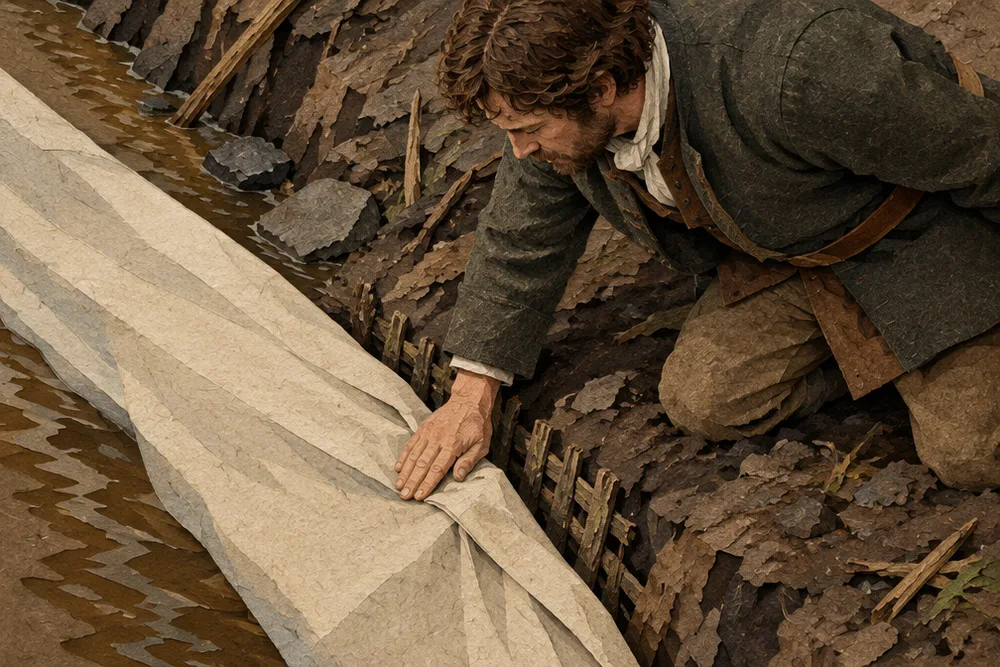
The men began arranging the canvas. Dodd knelt to push its folded edge into the narrow cut. The second laborer held a lantern by its handle, though the afternoon was not yet dark enough to need it. Their hands worked slowly. The plug was not designed to seal a dressed culvert; it was intended to stop seepage through an irregular opening. Peregrine watched the canvas settle against mud and stones. A line of bubbles rose just to its left, popped, and left a small ring on the surface.
“There’s air in the bank,” Varneck said.
“Possibly.” Peregrine lowered himself to inspect the bubbles. They had not risen in a steady stream. A single one, then two close together, then nothing. The river’s pressure might be driving air through a cavity. Or some burrowing creature might have disturbed the silt. He could not turn a bubble into a conclusion merely because it favored his doubts.
“Will it hold?” Varneck asked.
“The canvas should hold against the present flow.”
“That was not my question.”
Peregrine rose. The chair waited, rigid-backed, small hands back on his stick. In the cottages, a shutter clicked shut. He thought of the plan in his case: the embankment as a continuous stroke, the drain as a negligible mark. He had drawn that line before taking his first sounding here. He had called the old landing bell scrap because the stairs had shifted and the bell had been taken down. Yet Rosamund Trennick had heard a note through the mud, and his survey did not explain it.