Night School for the Coal Bills
Page 8 of 261
Chapters
Zella glanced at the register on the shelf. Its pages recorded who came, not what they learned. She could not put every recitation, every correction, every moment of courage in the columns. But she could make the record regular, and not pretend that a pupil’s presence meant she had understood. The thought unsettled the tidy plan she had made on the walk home from Rusk’s.
After class, she counted the attendance once more. The total was right. She checked the margin for the late arrival, then the cleared-room times. No mark had been lost. The ink on the first leaf had dried with a thumbprint where she had steadied the page. She did not rub at it.
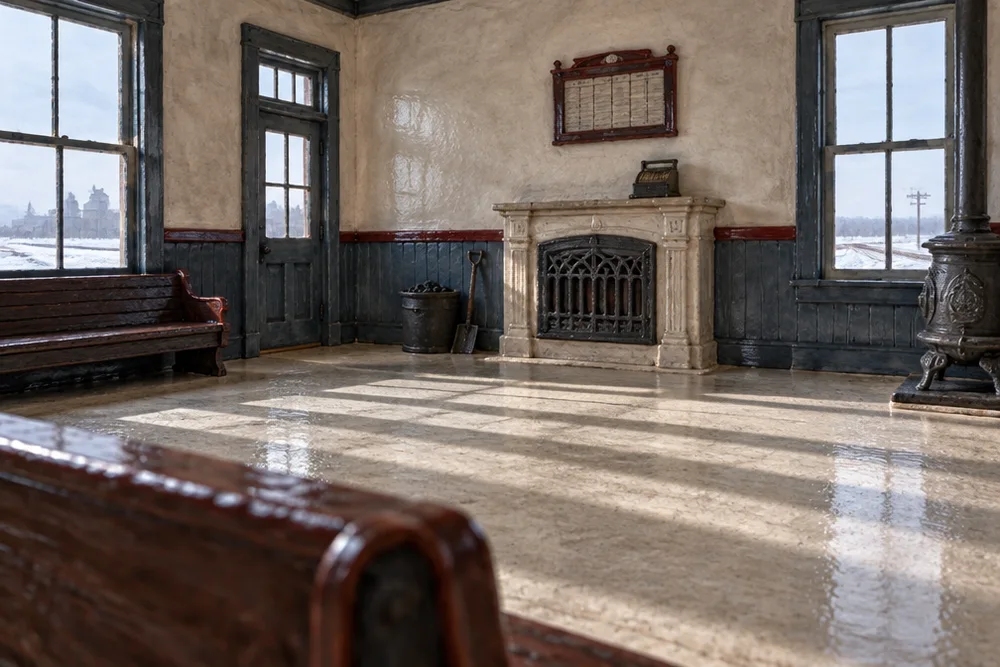
A week later, Zella found Orin checking the timetable frame beside the grille. The printed sheet showed the winter connections in narrow black lines. He had one hand on the frame and the other on a small ledger, his sleeve guards buttoned over his cuffs.
“May is still a long way off,” she said.
“Not to a timetable.” He tapped a line with one blunt nail. “The spring connection takes the evening gap. The room will be needed for passengers.”
“I know.”
“You’ve kept the five minutes?”
“Every night.”
“And the pupils?”
“They’ve learned to clear the room without waiting for me.”
Orin studied her, then closed his ledger. “That’s better than a promise.”
“It’s a record.”
“A record is a promise somebody can check.”
Zella looked at the timetable. Its dates seemed to crowd the frame, though the spring line was still weeks away. “I’m keeping one.”
He bent under the doorway as he left. “Then keep it so the truth doesn’t have to squeeze into the margins.”
The words followed her into the lesson. She did not know whether he meant the school or the railway, and did not ask. When the pupils came in, she wrote a reading passage on the board and set the register open at her side. She took attendance as each person arrived, not before, and asked one of the older girls to show her how she kept track of the evening when she had to leave early to help at home.
“You can put the time here,” the girl said, pointing to the margin.
“Would you rather I did?”
“Yes. My mother asks how long I stayed.”
Zella wrote the time and left room for the next one. It was a small change, but it made the page less clean and more useful. She knew that a board member might prefer one neat mark beside each name. She did not erase the time.