A Key for Every Winter
Page 99 of 209
Chapters
“It might,” Mae said. “We need one flyer that tells them the actual hours, and a separate notice for the closed nights. I can’t promise everyone will see it.” She wrote that down too. She was careful not to turn the limitation into a clever phrase. Hollis watched the paper gather its honest edges: hours, staffing, transport, and a place to post changes. There was no word for all the people who would arrive outside the schedule.
“The shuttle?” Hollis asked. “We’ll list the county pickup information,” Mae said. “That doesn’t mean the shuttle replaces this room.” “No,” Hollis said. “It doesn’t.” Her voice came out sharper than she intended. The bus and the shuttle could move people; they couldn’t make an exposed stop warm or guarantee a seat when a route changed. Mae added a note that transportation information had to be checked before each posting.
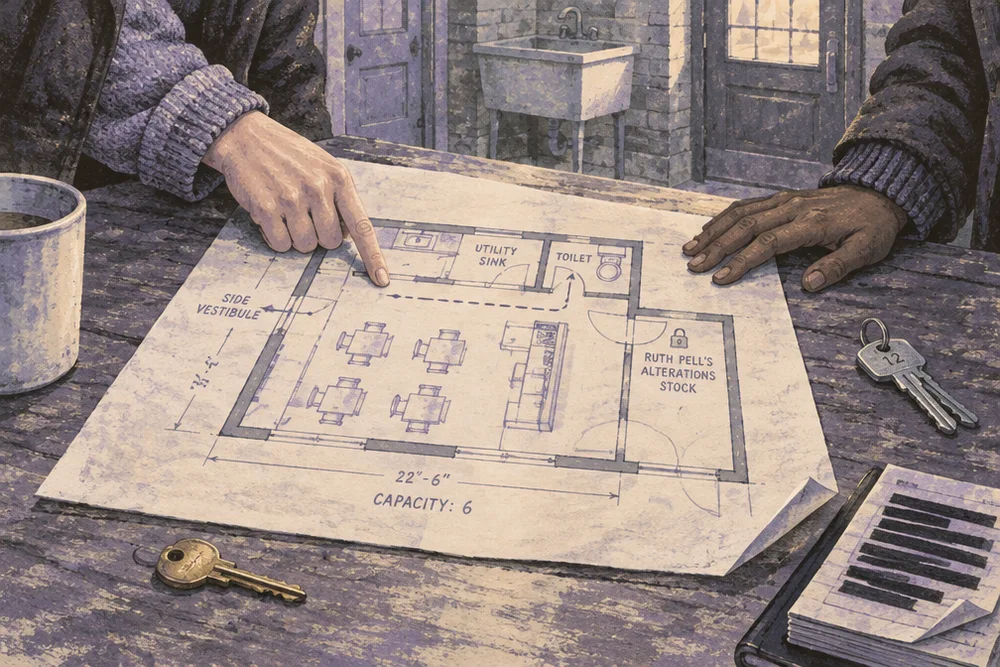
Iona flattened the lease drawing at last. The proposed partition left a clear route from the side vestibule to the toilet while keeping Ruth Pell’s alterations stock behind a lockable boundary. With the bench gone and fewer chairs, the room’s capacity would be small. The roster would not fix that, and the roster could not make the shop a municipal facility. Iona traced the marked route with one finger, careful not to cover the dimensions.
“How many people fit?” she asked. Mae gave the working number from the inspector’s walkthrough. It wouldn’t be final until he approved the finished layout. Hollis could picture the sign by the door, the one that would have to turn from room available to full. “Then we need a way to record turnaways without names,” she said. “And we should record when the shift doesn’t open, separately.”
Mae wrote both into her notes. “I can report capacity and openings. I can’t make the contract promise a seat to everybody who comes.” “I know,” Hollis said. The people who had been coming didn’t need her to pretend otherwise. What they needed was to know whether the door would open, and what to do when it didn’t. She had spent too long treating a key as an answer to both questions.
Iona folded the drawing on its old crease. “I’ll make sure the operating agreement says the hours are the hours. No informal extension on the side.” Hollis glanced at her sister. “Even if somebody asks you?” “Especially then.” There was a carefulness in Iona’s voice, as if the sentence had cost her something. Hollis had no way to know how much, not yet. She nodded once.