A Key for Every Winter
Chapter 4 · The Blank Tuesdays
Page 33 of 209
Chapters
Iona had written the question in the margin of a laundromat receipt: ATTENDANCE—TOTALS? She held it down with the lavender checkbook while the receipt’s curled end kept lifting in the draft from the alley door. “Not a story,” she said. “Numbers. How many people came, how many nights you opened. If we’re going to ask anybody to pay for this, they’ll want to know what they’re paying for.”
Hollis set a bakery bag on the folding table. Her clogs left two damp prints on the concrete, and flour showed pale along the front of her quilted vest. “You want numbers, you should’ve asked before the video went around.”
“I am asking now.”
“Right. Now there’s a hearing packet, a sale date, and ten days to teach a room to be a service.” Hollis glanced at the receipt. “You want me to make it neat enough that nobody has to hear what it was like?”
Iona’s elbows drew close to her ribs. She looked tired, but not in the way that made Hollis want to soften. “I want it accurate.”
Outside, a freight train moved beyond the rail underpass, low enough to tremble the window glass. The dryers were unplugged for the inventory; their round doors reflected the two sisters in dull gray circles. Hollis sat. Iona stayed standing. The space between them had the exact width of the table and all the old arguments neither of them had entered on a form.
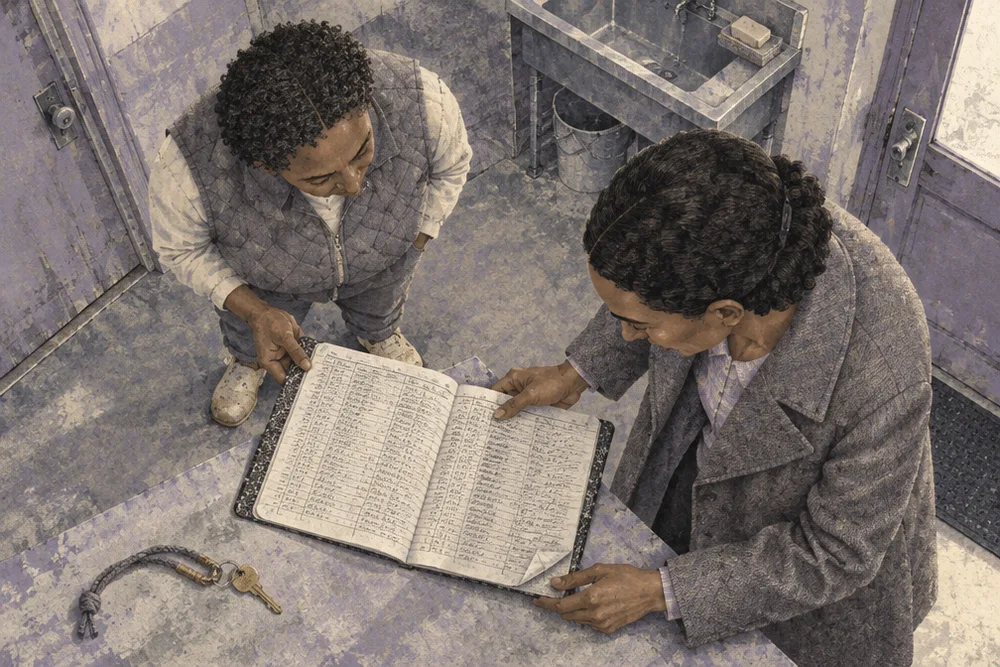
Hollis opened the weather log. It was a school composition book with a bent cover, its lower corner folded from being carried in her vest pocket. She had ruled columns by hand: date, temperature, opened, people, notes. The first pages were crowded, the later ones crowded differently, with names crossed out and small explanations written in the margins.
“This says fourteen on January sixth,” Iona said. “Did fourteen people come?”
“Fourteen came through the door.”
“And the next column says six.”
“Six stayed past the first hour. The rest warmed up, used the toilet, called somebody, caught a ride. They count as coming.” Hollis tapped the paper with one blunt fingernail. “That’s why I kept both.”
Iona leaned over the book. Hollis watched her hands rather than her face. When they were girls, Iona had been the one who could divide a grocery bill without a calculator. She had carried that skill into payroll, where a missed hour had a cost you could print. Hollis mixed dough by touch, adjusting for a room’s heat and the flour’s dampness without ever calling it a measurement.
“There are blank Tuesdays,” Iona said.