A Key for Every Winter
Chapter 14 · Key Number Three
Page 138 of 209
Chapters
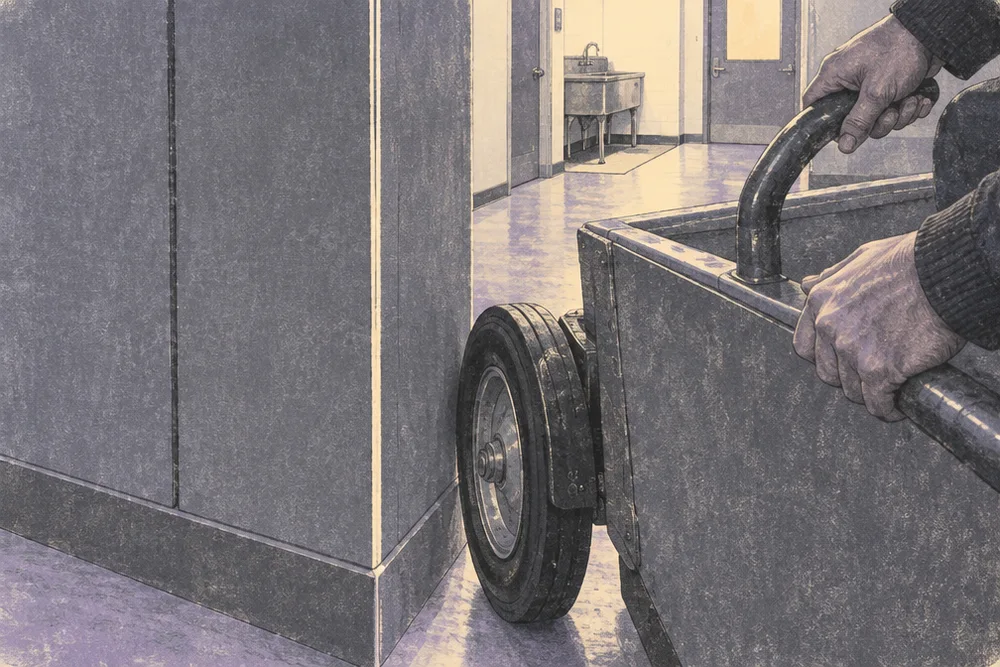
The partition had gone up in gray panels, clean-edged and still smelling faintly of cut wood. It split the back room from Ruth Pell’s stock, leaving a passage to the toilet that ran along the shop wall. Hollis stood in the alley with her hands in her vest pockets, reading the new arrangement through the open door. The alley door remained left of the utility sink. The shop door faced it across the machines. The room was smaller than the one she had been opening by instinct for four winters, and there was no bench.
Ruth came through from the shop, tape measure at her waist, gray sleeve protectors pushed to her elbows. “We can test it with the cart before the inspector gets here,” she said. “I don’t want to hear that the turn is fine because nobody tried it carrying anything.”
“Good,” Hollis said. “The room’s supposed to work for people carrying things.”
Ruth glanced at her, then nodded once. She had not asked Hollis to reassure her about the sale or the lease. Ruth had bought a building and moved a business into it; she needed the cart to turn. Hollis was learning that a useful question could be smaller than a promise.
Ruth went inside and brought out a stock cart loaded with folded lengths of cloth and two cartons. One wheel rattled over the shop threshold. Hollis moved aside as Ruth steered it toward the partition, then stopped short where the aisle bent. The cart’s handle swung close to the new wall. Ruth backed it, turned the front wheels, and tried again, slower. A carton shifted; she caught it with one hand without letting the cart roll.
“That’s the pinch,” she said. “If I come through with a delivery, I can’t turn while the room’s being used.”
“The door’s clear,” Hollis said. “But you need the turn.”
“I do. My people need to move stock without walking through a room full of guests. And the toilet route has to stay open.” Ruth angled the cart and worked it around the corner on the second try. It passed, barely, with one wheel nearly brushing the partition. “I can make that work, if nothing sticks out into the aisle.”
Hollis looked at the clear strip of floor. She remembered chairs pushed into corners, coats hung from whatever would take a hook, people making room for each other because there was nowhere else to put their elbows. The new room could not stretch to accommodate every need simply because she wanted it to. “We’ll mark the line,” she said. “No chairs past it.”