A Key for Every Winter
Page 79 of 209
Chapters
Mae wrote something in her notebook. Hollis could not see what. “Could we borrow higher chairs from Switchyard?” she asked.
“Maybe,” Mae said. “But borrowed furniture doesn’t change the clear route. And we need to know how many seats the room can hold once that route is protected.”
The question landed with a weight no one assigned it. Hollis pictured the room on the coldest night she remembered: coats over every chair back, people standing near the sink, Cal’s robe cuffs pulled over his hands. She had always been glad to see the room full. Now the memory had edges. A full room could mean somebody could not move through it.
She pulled the floor plan from the window ledge. “Let’s measure the seats we can keep, not the ones we wish would fit.”
The inspector arrived carrying a clipboard and a metal tape measure. He introduced himself, but Hollis caught only his surname and then lost it beneath the scrape of the tape. She gave him the plan Mae had marked up. He examined it, then walked the route without looking at the paper.
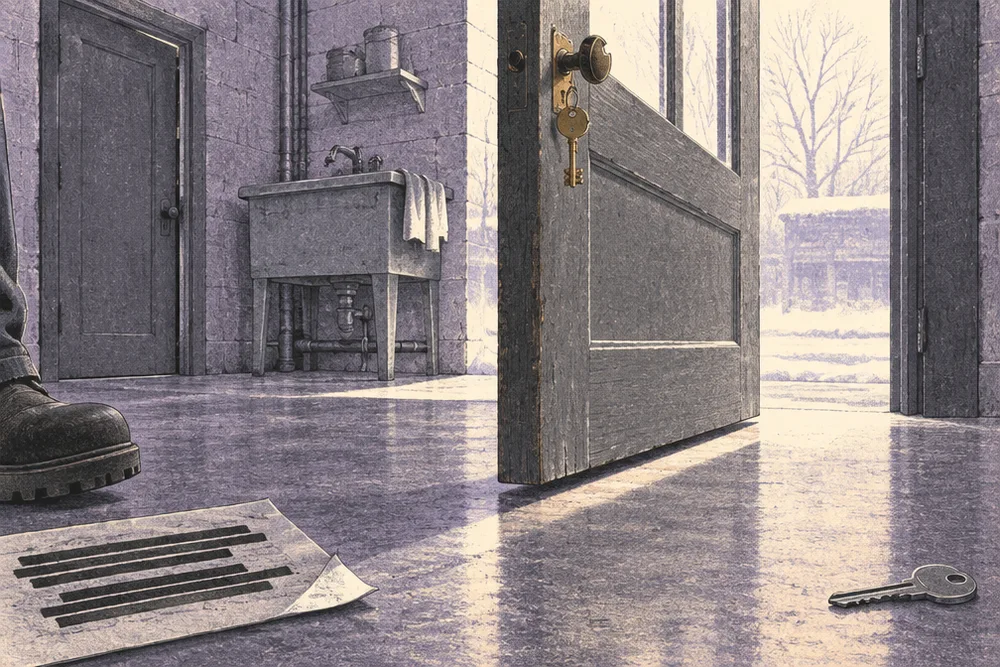
He began at the back room, passed the place where the bench had stood, and went through the side vestibule. Hollis followed two steps behind. The utility sink narrowed the passage. The shop door opened toward the route, its edge swinging into the space where a person might be standing.
“That door’s going to have to change,” he said.
Hollis looked at the door as though it had only now begun to move. “It opens into the route.”
“It does.” He measured the swing. “The public path needs the clear width through the turn. If somebody’s coming through while the door’s open, there isn’t enough room.”
“Could we put a stop on it?”
“Not as it stands. You’d need to correct the swing, then I’ll measure it again.” He marked the clipboard. “I can’t approve this today.”
The words were not angry. That made them harder to push against. He was describing a thing the door did, not judging what Hollis had intended.
Mae came into the shop. “What about the bench?”
“It’s out of the route for now,” Hollis said.
The inspector looked at the empty space, then at the folded chair beside the wall. “Keep the route clear. A chair can be present only if it doesn’t reduce that clearance.”
“And after the correction?” Hollis asked.
“I’ll return. If the door swing is corrected and the route meets the measurement, I can approve it. Until then, no public opening.”