A Key for Every Winter
Page 199 of 209
Chapters
Ruth had brought a copy of the shop’s new route notice. In the lobby, she unrolled it on a narrow ledge and smoothed the corners with her palm. The paper showed the municipal site, the bus exchange, and the walking route between them. The public opening date was printed in large type; beneath it were the hours the pilot would actually cover. The gaps were printed too.
“I can put this in the front window,” Ruth said. “People will see it when they come for their alterations. But I’m not taking calls about whether the site is open. That number belongs to the department.” She tapped the contact line with one blunt nail.
“It should,” Iona said.
Ruth glanced at her. “You’re sure?”
“Yes. The city owns the schedule. It should answer for it.” Iona took the notice and checked that the dates matched the motion. In another season, she might have offered to keep a spare key, or to be the one who knew where to send someone after closing. She had learned the difference between being useful and becoming the unmarked extension of someone else’s plan.
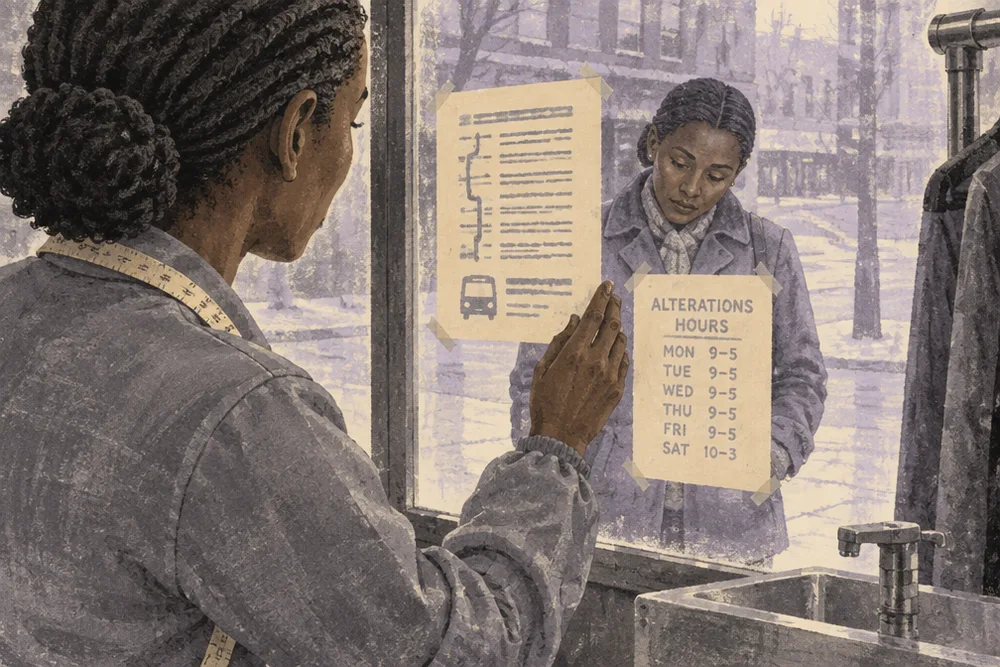
At Weller Wash, Ruth taped the notice inside the front window beside the alterations hours. The buttercream paper showed warm against the gray street beyond it. A customer paused on the sidewalk to read. Ruth let her read without stepping outside to explain. The route was public; it did not belong to either sister to interpret privately.
Iona walked through the shop once while Ruth checked the tape at each corner. The utility sink was dry. Behind the partition, alterations stock sat in clean, ordered rows, protected by the lock on Ruth’s side. The back room no longer looked like the temporary place they had made from a family promise. Its chairs had gone to the municipal site; the clear route to the toilet remained open for shop customers. The alley entrance stayed shut.
She stopped near the door. The brass original key was not on Hollis’s braided cord anymore. It had gone back with the estate papers and the closing records, its nicked bow visible in the envelope where Iona had filed it. For years she had thought a key was an answer: copy it, hand it over, make sure somebody could get in. Now she understood how much else had to be there—paid time, a working route, a place to go when the chairs were full, someone whose job it was to answer for the hours.
Hollis stood by the front window. “The date’s plain enough,” she said.