A Chipped Sugar Bowl and a Missing Street
Page 8 of 243
Chapters
Outside, the river pressed at its banks. From the window, the payroll office looked untroubled, its roofline fixed against the grey sky. Beth returned to the counter and set her pencil beside the sugar bowl. Three pounds, she had written. It seemed absurd to ask anyone to pay for a chipped bowl while a stranger waited above rising water.
She left the price where it was. A price could be changed later; a name and number, once lost, were harder to retrieve. She copied Nisha’s mobile into a clean page of her notebook, checked each digit against the two versions, then drew a box around it. Underneath, she wrote: payroll office, loading terrace, opposite bank. No recognized location.
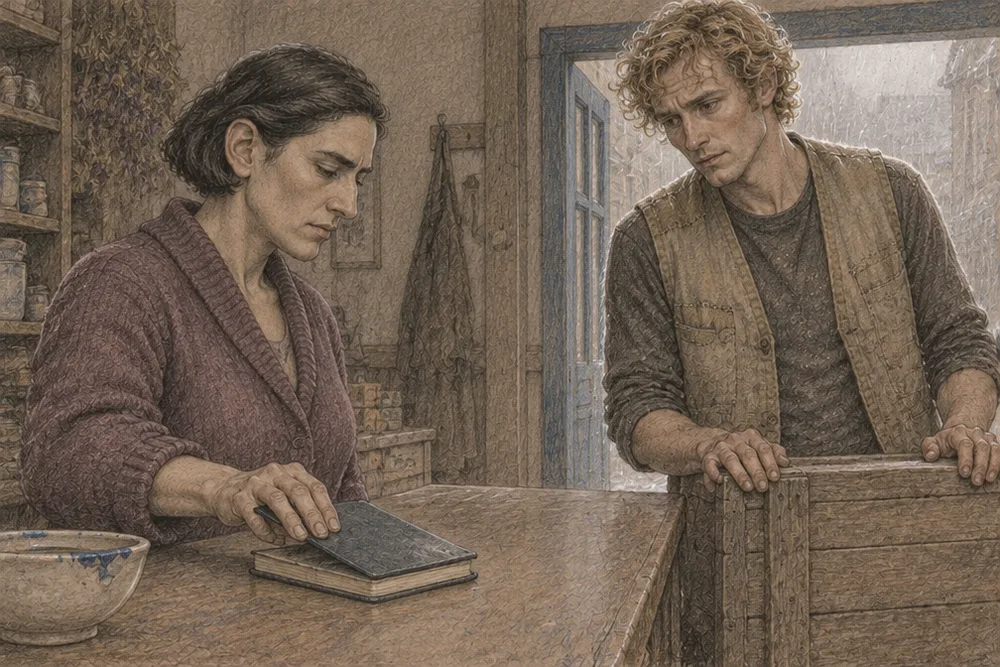
The shop door opened at a quarter past eleven. Lewis came in backwards, holding the door with one shoulder while he carried a wooden crate against his chest. Tall and narrow through the body, he leaned hip-first as he set the crate down. His sandy curls were damp at the edges. The patched canvas vest he wore had a streak of sawdust along its pocket.
“You’re still here,” he said. He glanced at the brass hooks on the counter. “Good. I can take those.”
“There’s a flood call,” Beth said.
His expression sharpened. “What?”
“Someone at the payroll office across the estuary. The bridge road’s flooded. I’ve passed the report to the duty desk.”
Lewis looked toward the window, as if the distance could be crossed by the force of his concern. “Anyone hurt?”
“I don’t know. Nisha and two others are upstairs. She says the entrance is under water.”
“And the desk?”
“They have the building marked clear. They’re checking.”
He put his hands on the crate, but did not move it. For a moment he seemed to be searching for a thing he could lift or fix. Then he asked, “Do they know where she is?”
“Not exactly.”
“How can you not know? It’s the payroll office.”
“They have the building. They don’t have the terrace.”
Lewis looked at her notebook. Beth closed it before he could read the number. “I’ll call the desk again,” she said. “I don’t want the number passed around.”
“Of course.” He kept his voice gentle, but his eyes stayed on the notebook. “I can go down to the quay and look.”
“There’s nothing useful you can see from there.”
“I can try.”
Beth imagined him driving toward the river, taking a wet road because it felt like doing something. “Wait until the desk tells us what they need. If they want a local landmark, I’ll give it to them.”