A Chipped Sugar Bowl and a Missing Street
Chapter 1 · A Price on the Chip
Page 1 of 243
Chapters
The sugar bowl had a blue rim and a chip the size of a fingernail missing from its lid. Beth Aercombe turned it under the desk lamp, trying to decide whether the damage belonged in the price or the description. The lamp made a hard white coin on the counter and caught the chip’s rough edge. A customer might call it character. A buyer of second-hand crockery might call it a reason to offer half.
She wrote £3.50 on a strip of masking tape, then crossed out the fifty and made it three. Ruth would have charged more. Ruth had believed the right price was the one that made a person stop arguing and take the thing home. Beth had spent the morning discovering how many of her aunt’s prices had been guesses dressed up as certainty.
The shop occupied the old ferry terminal’s ticket hall, above the reach of ordinary tides and below the reach of nobody’s bills. Its windows looked over the estuary to the payroll office on the opposite bank, a long brick building with a loading terrace and a roof patched in three shades of felt. Behind Beth, the old ticket hatch divided the room from a narrow back passage. Above it, a clock without hands showed a pale circle on the wall.
She had come to clear the place, not restore it. The lease could pass to Ada, who wanted the quay door for repair deliveries, if the paperwork was signed by Friday. Otherwise another month’s rent would fall due, and Beth had neither the money nor the appetite to keep paying for shelves of cups, tins, and half-remembered obligations. Her cousin Lewis was co-heir. He had not yet said whether he would sign.
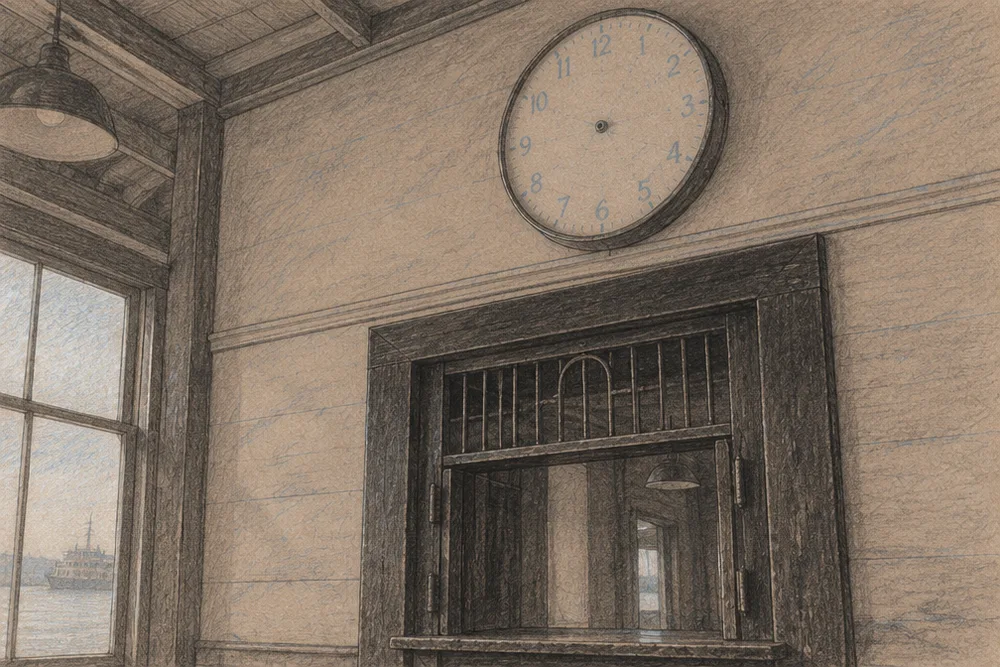
Beth turned the bowl over and found the maker’s mark rubbed almost smooth. She could hear the clockless room: a gull crying outside, a delivery van changing gears on the quay road, the dry scrape of tape pulled from its roll. Then the wall phone rang.
The sound was so abrupt she knocked the bowl against the counter. It gave a small, bright clink. The phone rang again, a bell beside the ticket hatch, where dust had settled around the black plastic cradle. Beth stared at it. The line had been silent for eleven years.
She had been twenty-nine when the ferry service stopped, old enough to know that a quiet line was not necessarily a dead one. The company had left the extension in place while the building changed hands, then Ruth had kept it because it was there. Beth had told her more than once to cancel it. Ruth had answered that it cost next to nothing, which was not the same as saying it cost nothing.