A Chipped Sugar Bowl and a Missing Street
Page 27 of 243
Chapters
Lewis’s hand found the pencil tucked into the map’s fold. He didn’t mark it yet. A wrong line could send a crew into water. He leaned closer, looking for the assumptions built into the neat printed shading.
Beth opened the terminal’s old wall cupboard. Inside, a jumble of obsolete ferry timetables, tide charts, and damp cardboard tubes leaned against each other. She pulled out a pair of binoculars with a cracked leather strap. “These are Ruth’s,” she said. “They may still focus.”
“You kept binoculars in the shop?” Lewis asked.
“Ruth kept everything in the shop.”
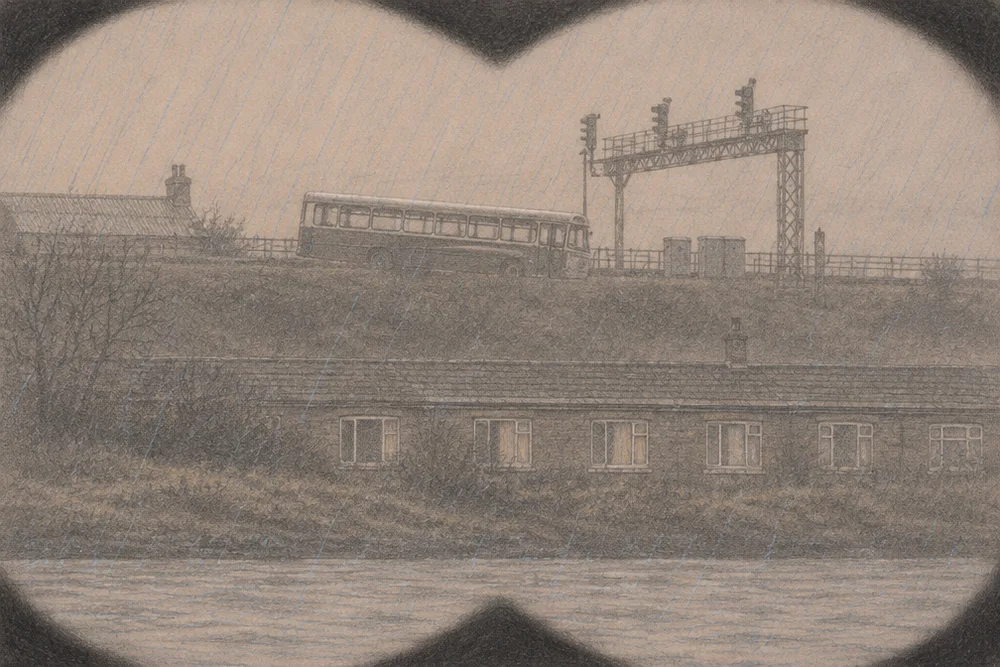
He took them and stepped onto the raised quay. The wind needled rain against his cheeks. Below, brown water boiled around the ferry stairs, leaving a line of foam on the stone. Across the estuary the payroll office’s windows showed as yellow rectangles, the lower ones lost behind weather. He tried the binoculars. The glass made the world jump, then steadied on the far bank.
There: a maroon bus, angled across a road. Its rear end sat lower than the cab, as if the road dipped beneath it. The roof of a low building showed past the railway bank. Below the bus, scattered lights glowed in a line, almost obscured by rain. Lewis turned the binoculars left, then right. A long strip of fence ran down from the road to a green board. The sign was too small to read.
“Can you see the nursery?” Ivo called from the doorway.
“Maybe the sign. I need a sightline.”
Beth came out beside him. “The caller could see the railway fence from the back room. And the cottage lights beyond the nursery.”
Lewis lowered the binoculars. “The nursery backs onto the row?”
“I don’t know.”
“It used to have a service lane, didn’t it?”
“Not on the map.”
“That’s not what I asked.”
Beth’s mouth tightened. “There was a gate behind the nursery. Before the railway fence was extended. Ruth used to take me that way to the old cottages. I thought they’d all been cleared.”
The answer settled somewhere between them. The view from the nursery’s back room, the bus looking down, the line of lights through the binoculars: three views that might overlap. If the cottages stood behind the nursery, the bus might be above them on the embankment road. The flood annex showed nothing there because it called the whole area railway land.
Lewis looked again. The bus’s windows were level with a signal gantry beyond the bank. Beneath it, those lights were not a distant town reflected in water. They were house windows. “I think there are homes there.”