A Chipped Sugar Bowl and a Missing Street
Page 212 of 243
Chapters
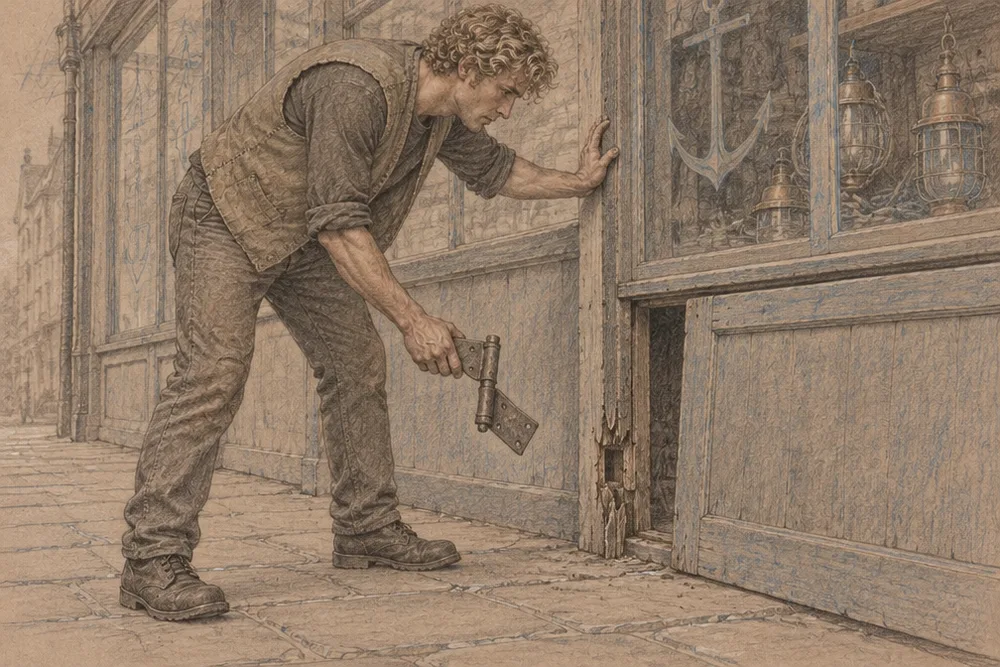
Ada’s repair shop had once been a chandlery, and its front windows still carried the faint outlines where painted anchors had been removed. The glass was newly cleaned, the door propped open with a rubber wedge, and a row of repaired lamps sat in the window with their cords coiled neatly beneath them. Lewis arrived carrying his canvas tool roll and the council letter in his inside pocket.
Ada stood at the counter in bib overalls, measuring a brass latch against a piece of scrap wood. Her copper hair was clipped close at one side, and a red kerchief kept the longer section off her face. She had the steady stance of someone who knew exactly how much space she needed and expected the rest of the world to accommodate it.
“Hatch first,” she said. “Then we can talk about your letter.”
The counter hatch opened onto the pavement, where customers could leave small repairs without coming inside. Its lower hinge had pulled free from the old timber, and the panel sagged whenever Ada lifted it. Lewis set down his tools and ran his fingers along the frame. The wood was sound in places and soft in others. He showed her the split where the screw had worked loose.
“I can replace that section,” he said. “New hardwood, sealed, two coats of paint. It’ll take most of the morning.”
“How much?”
He gave her a figure. It was not the family price he might once have offered without thinking. He included materials, travel, and the hours he would not be earning at the joinery where he had started picking up regular work again. Ada nodded once, then wrote the amount in a small ledger.
“Agreed. I’ll pay when it’s done.”
The plainness of it made him pause. She was not asking him to rescue the shop, or to prove that he belonged in it. She had a broken hatch; he knew how to repair one. They had agreed what the work would cost.
Lewis rolled up his sleeves. He measured the opening twice, removed the bent hinge, then cut away the softened timber with a fine-toothed saw. Through the hatch he could see the till, a jar of screws, and a customer’s cracked radio waiting on a cloth. The shop smelled of warm dust and metal filings, a practical smell, without the drowned-paper odour that had clung to Ruth’s place for weeks.