A Chipped Sugar Bowl and a Missing Street
Page 165 of 243
Chapters
Lewis placed his pages beside it. “The arguments are how we know which descriptions overlap.”
Ivo read the notes, lips pursed at the repeated versions. Old wall. Glasshouse Corner. The Cut. Low road. Railway Bank. The Back. Ridge. “If they all go in, the desk has to know which one to ask for.”
“That’s why I’ve drawn the sightlines.” Lewis pointed out how the dead lamp post and nursery shutters framed the low stretch. “You don’t need to decide what it’s called. If somebody says ‘past the old wall, before the shutters,’ it’s this section. If they say the Cut, ask about the high kerb.”
One of the operators turned slightly in her chair. “And if they say the Back?”
“Ask whether they mean the path or the road.”
Ivo picked up the paper and held it at arm’s length. The route had been plain enough when drawn from above, a thin line between the embankment and a row of small blocks. But the words were no longer just words. Each one came with a remembered direction, a point of view, a person who had been told before that the place they lived did not count as a place.
“You’re not choosing,” Ivo said.
“No.” Lewis slid the greaseproof sheet toward him. “I’m trying to keep the choices usable.”
They took the notes to the wall map. Ivo had cleared a rectangle beside the dispatch desk, where the town’s familiar grid stopped at a pale blank area marked RAILWAY LAND. Lewis pinned the greaseproof paper over it with two magnets. The paper fluttered whenever the depot door opened, and the sketched street showed through the blank beneath like a pencilled seam.
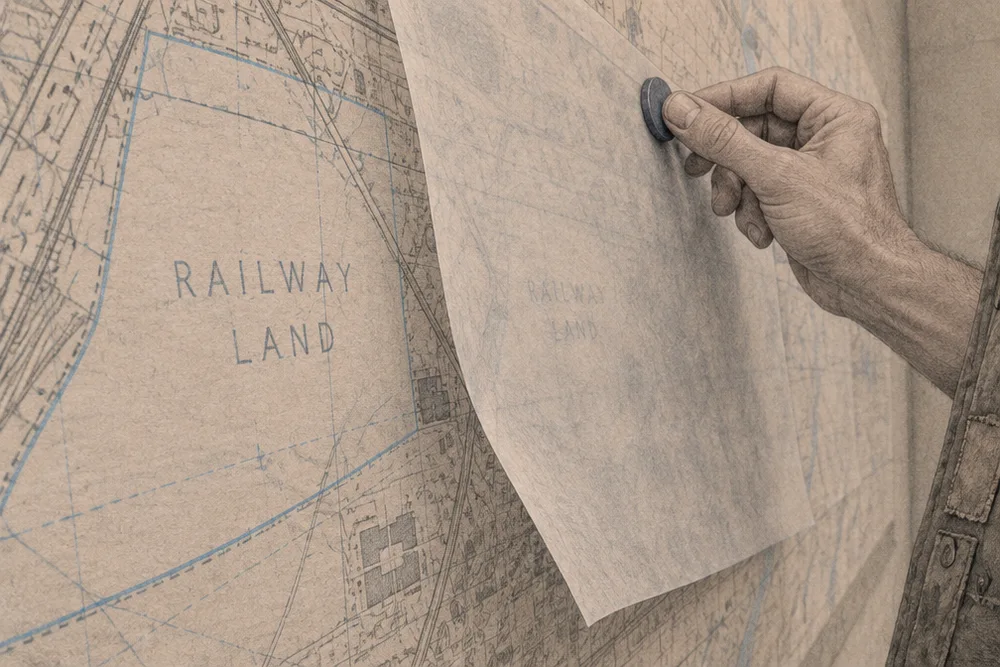
A dispatcher named Faye stood with her arms folded. She had been working the alert desk during the flood and had sent a crew toward the low entrance before Beth corrected the route. Now she studied Lewis’s marks without speaking.
“This label here,” she said at last, “Glasshouse Corner. If someone says that, I ask what they can see.”
“Yes,” Lewis said. “The dead lamp post, the nursery shutters, or the old wall.”
“What if the lamp post isn’t visible at night?”
“Then the wall and the shutters.”
“And if they’re inside?”
Lewis looked at the drawing again. The sketch had become too tidy. “Ask which way the ground slopes. Or whether they can see the railway lights.”
“There aren’t railway lights on that side anymore,” said Ivo. “They changed the signal lamps.”