A Chipped Sugar Bowl and a Missing Street
Page 101 of 243
Chapters
A woman whose name was missing from the ledger answered from a borrowed phone. She had called from the row after a neighbor passed the shop number to her. She agreed to the general fact that Sill Row had been omitted, but said the town must not list her home as occupied while repairs were pending. Beth wrote that sentence carefully, then underlined it. A map that marked every damaged home as empty could decide, without asking, who deserved a knock.
Nisha watched the pencil move. “That’s the part people won’t see in a photograph.”
“We can put it in the route notes,” Beth said. “A household can be displaced and still need the service to reach it.”
“No. They need to ask whether a person wants the house treated as occupied. Sometimes the answer is no.”
Beth stopped writing. She had been thinking of access as a route, a connection between the caller and the crew. Nisha was speaking of the consequences after the crew arrived: the name on a list, the assumption that a home was safe to enter, the certainty that someone would return. She crossed out OCCUPIED STATUS and wrote CONTACT PREFERENCE, TO BE CONFIRMED.
“That’s better,” she said.
“It’s less certain.”
“Good.”
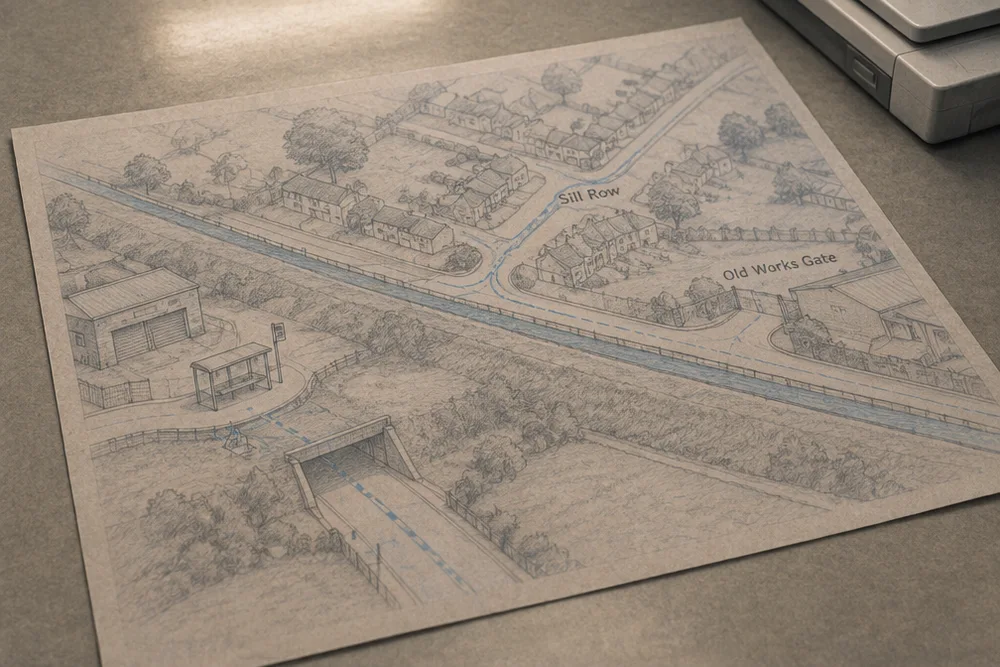
Mara had waited in the depot lobby with her notebook closed. When Beth came out, she asked whether they had enough to make a story without the ledger. Beth gave her the folded dispatch sketch, but not the call slips. On a separate sheet she wrote three landmarks in plain terms: the old works gate, the shuttered nursery, the bus stop sightline. She drew the embankment as a hard line and the cottages behind it, with the low underpass marked as vulnerable to water.
Mara studied the sketch. “This is enough to show a street, not an individual.”
“That’s what we’re offering.”
“Can I take this sheet?”
Beth said she would make a copy with Ivo and check that the location labels did not identify callers. Mara waited while they did.
Ivo found a photocopier in the records room that still took paper without pulling it sideways. Beth fed in the route sketch, then examined the copy under the strip light. The copier had rendered the pencil marks as soft grey bands. Sill Row was still legible; so was the old works gate, which had long ago lost its sign. No personal details appeared anywhere on the page.
“This can go out,” she said. “The original stays with the operational notes.”
“And the consent sheet?” Ivo asked.