What the Tiles Remember
Page 52 of 220
Chapters
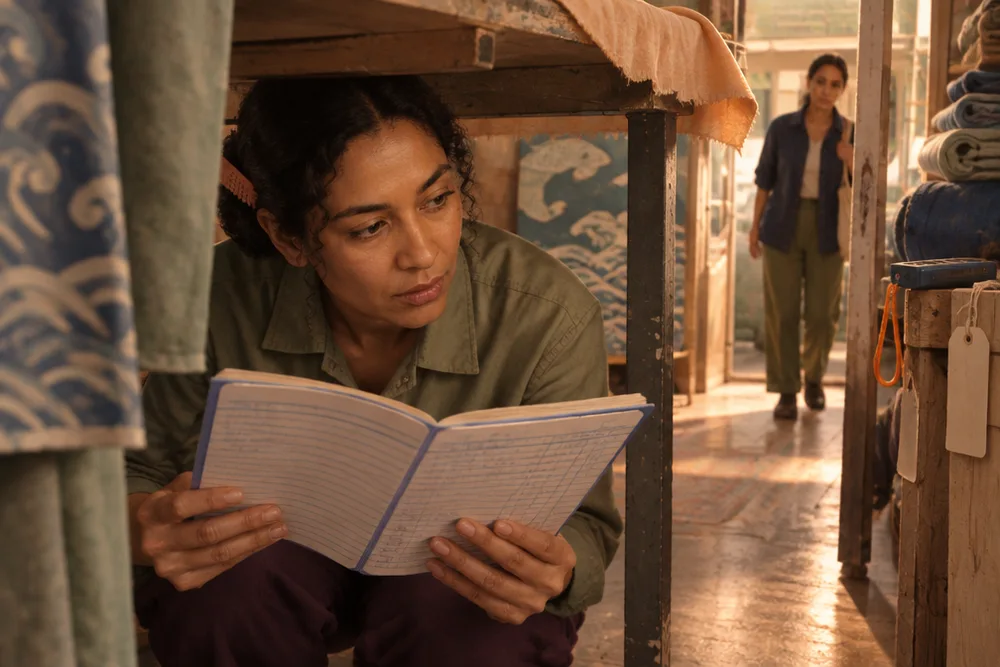
The entries were not a design plan. Ada had listed dates, amounts, and names or initials beside brief descriptions: two white fish from the night cleaner; a green curl from the twins after school; three bowls of tea for whoever stayed late. Some lines had money beside them, others a number of hours. On several pages Ada had written a phrase Mara recognized from her childhood: debt of thanks. She had used it for work people did for one another without charge. Mara turned the pages more slowly. There were thirty-one distinct marks of contribution, perhaps more if some initials appeared twice.
She heard the shop bell and closed the book, but Deni Voss was already stepping inside, her cloth trolley bumping lightly over the threshold. She wore a quilted saffron gilet, and a crescent scar cut through her left eyebrow. She walked toes out, sturdy and unhurried. “You said you wanted me to look at the pieces,” she said. “I can come after I’ve done the shopping.” “I’m glad you came now,” Mara replied. She set the book on the counter but did not push it toward Deni. “I found something that might help identify whose hands were there.”
Deni looked at the blue cover, then at the rolled mural photographs. “My sister used to talk about the baths,” she said. “Not as if she owned a piece of them.” She put both hands on the trolley handle. “Show me what you’ve got, and don’t make her into a story before I’ve seen it.”
Mara laid out the photographs that showed the lower waves and brought the receipt book closer. Deni leaned over the cutting table, eyes narrowing at a small cluster of marks near a pale fish. “There,” she said. “Those are my sister’s initials. R.V. She made them uneven because her hand shook after a long shift.” Mara looked from the picture to the book. The letters appeared in a line beside a note about a tile that caught the light like a shallow bowl. “I thought she made bowls,” Mara said. “She did. But she didn’t want her name put up anywhere.”
“Would you be all right with a photograph of the tile and a caption naming her?” Mara asked. She had meant the offer as recognition. She heard that now, after it was spoken. Deni’s expression closed a little. “No photograph of her. No name under the tile. She worked nights, and she kept that part of her life hers. She didn’t owe the town a story because she left something beautiful in a public room.” Deni tapped the receipt book once. “Ada could write down who helped. That doesn’t mean you get to announce it.”