What the Tiles Remember
Chapter 13 · The Wrong Side of the Wave
Page 133 of 220
Chapters
By the time Mara reached the oldest rows, the peach wall had stopped behaving like a wall and started behaving like a question. The upper bands had come away in tagged sections, their little wave marks arranged in crates at Rusk Depot. Below them, eleven rows narrowed toward the shared drain, where old mortar held dampness like a grudge. Only the bottom rows remained. The demolition crew’s notice was taped beside the hall door: access ended at noon on day six. The drain work for the occupied flats was already scheduled behind it.
Mara set the recorder on the bench, orange wrist loop curled beside its buttons. Ivo crouched at the wall, knees bent, long forearms braced above a line of numbered wedges. A cream tag hung from each gap he had tested. Their paper map lay open on a board, covered in Mara’s notes and Ivo’s measured taps. She had drawn the turns from memory; he had recorded what the wall actually gave them.
“Row eight, section C,” she said. “The phrase starts at the little dip.”
“Which little dip?” Ivo asked. He said it gently, but his finger rested on two different dips in the pencil line.
Mara hummed the tune Ada had used to count the last row while she worked. It rose, fell, and turned toward the drain. In Mara’s head, the turn came at the same place every time. In the tags, the notes and the tiles did not agree. The discrepancy was only one square wide, but that was enough to put the next section under the wrong number.
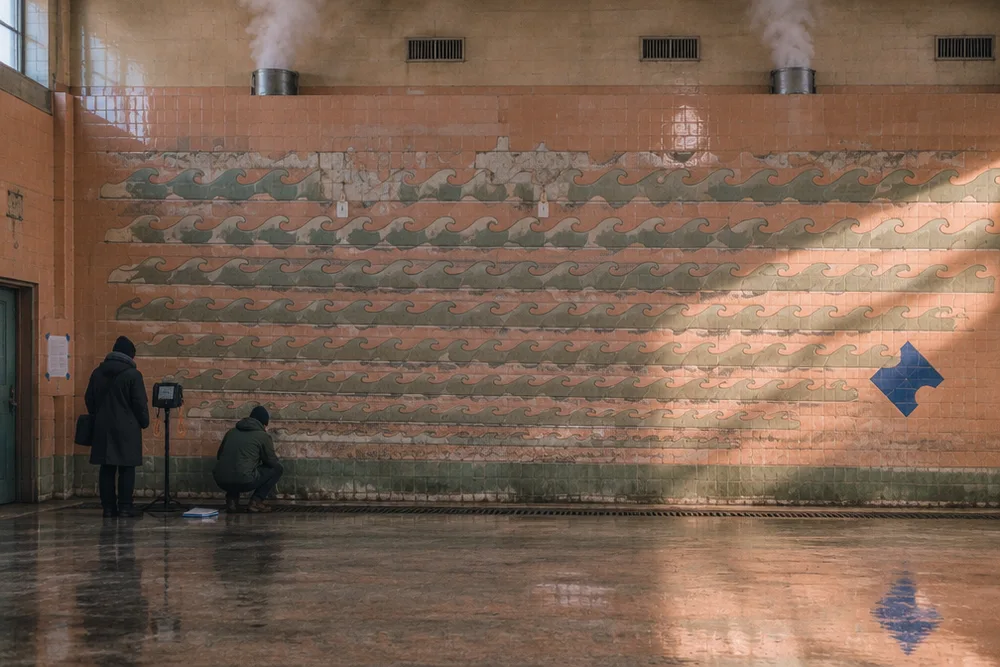
She stopped humming. “I know where it goes.”
“You know where you learned it,” Ivo said. “That might be different.”
The sentence landed with the small, clean weight of a wedge tapped home. Mara looked from the map to the wall. She had learned the song facing Ada, she realized, standing where Ada stood while her grandmother worked. The mural had been behind Ada, not in front of her. Mara’s remembered left might be the wall’s right. She had spent years thinking her body knew the arrangement because she had watched the arrangement take shape.
“We need to check before the next lift,” Ivo said. He didn’t reach for the recorder. “I can hold the section. You decide whether we mark it provisional.”
Mara turned to the map. Her own pencil line ran through the disputed turn, confident and wrong-looking. She could erase it, but then the paper would hide how they had arrived there. “Leave the line. Add a question mark.”