What the Tiles Remember
Chapter 2 · Two Taps for Empty
Page 11 of 220
Chapters
Mara might start with the photographs. I’m Ivo Maret, and I’d start with the tile that moved before I touched it. It shifted against its neighbor with a dry little click, no bigger than a fingernail, but Mara heard it over the hollow wash hall and stopped speaking. She had been trying to line up three cropped photographs on her phone: a blue curve, a row of pale fish, a corner of a painted sun. None showed where one image ended and another began. Behind her, peach-glazed walls rose to the steam vents, and the eleven rows of Warm Current climbed the length of the room like a tide caught mid-turn.
“That’s not a survey,” I said. I was crouched by the bench, knees bent, keeping my shoulder clear of the loose section. “It’s three pictures that happen to be of the same wall.”
Mara lowered the phone. Her chin came forward as she listened. A peach comb held her black coils low at the nape of her neck; yellow tailor’s chalk was tucked behind one ear. “I know what it is.”
“Good. Then we agree.”
She gave me a look that might have been irritation or the start of a laugh, but didn’t spend time naming it. “The bottom row’s the one I remember best.”
“Best isn’t the same as complete.”
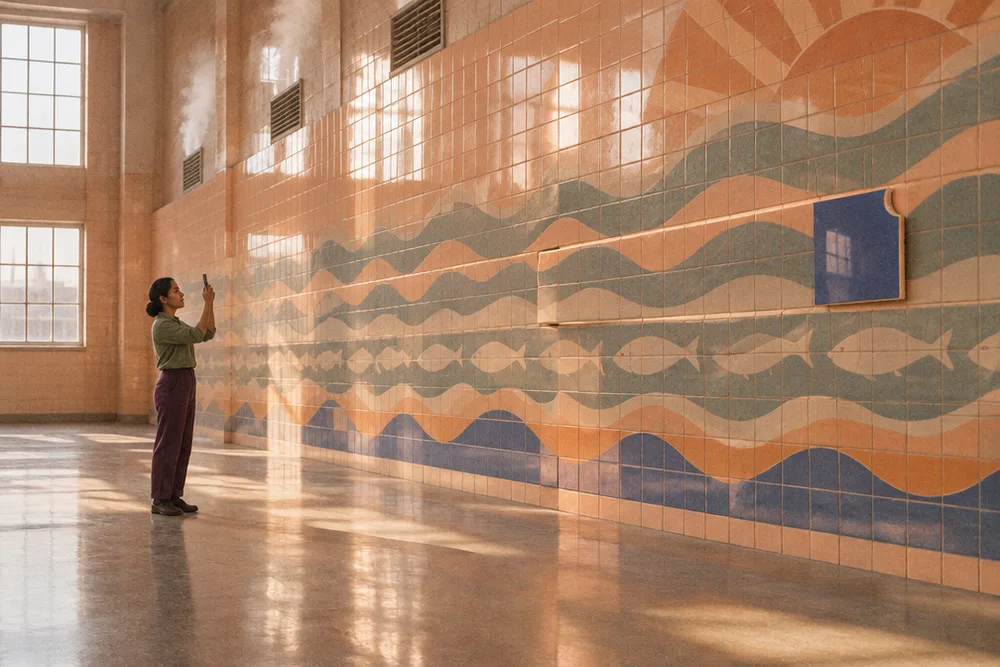
“I know that too.” She turned toward the wall again, and I saw that her fingers had closed around the phone hard enough to blanch at the joints. The deadline had made her carry the mural in her head as if attention alone could keep it from falling. She’d inherited it with the bathhouse, and six days remained before the demolition crew came for the building. The drainage replacement for the occupied flats couldn’t wait on a mural. Neither could my loading slot at Rusk Depot.
I set my tool bag down and opened the access sheet on the bench. “Before we touch anything, we read this again.”
“We read it yesterday.”
“Yesterday you were trying to keep a sale alive and I was trying to get through the door before the caretaker locked it. Today we have a moving tile.”
The approved limits were plain: work from the hall side, no entry behind the wall, no cutting into the shared drain chase, no powered tools until the surveyor had signed off the backing. I read each line aloud. Mara followed with one finger, pausing at the part that gave us access only during the posted hours. The building was shuttered, but not abandoned; municipal rules still held its walls together for the moment.
“So no lifting from the other side,” she said.