What the Tiles Remember
Page 31 of 220
Chapters
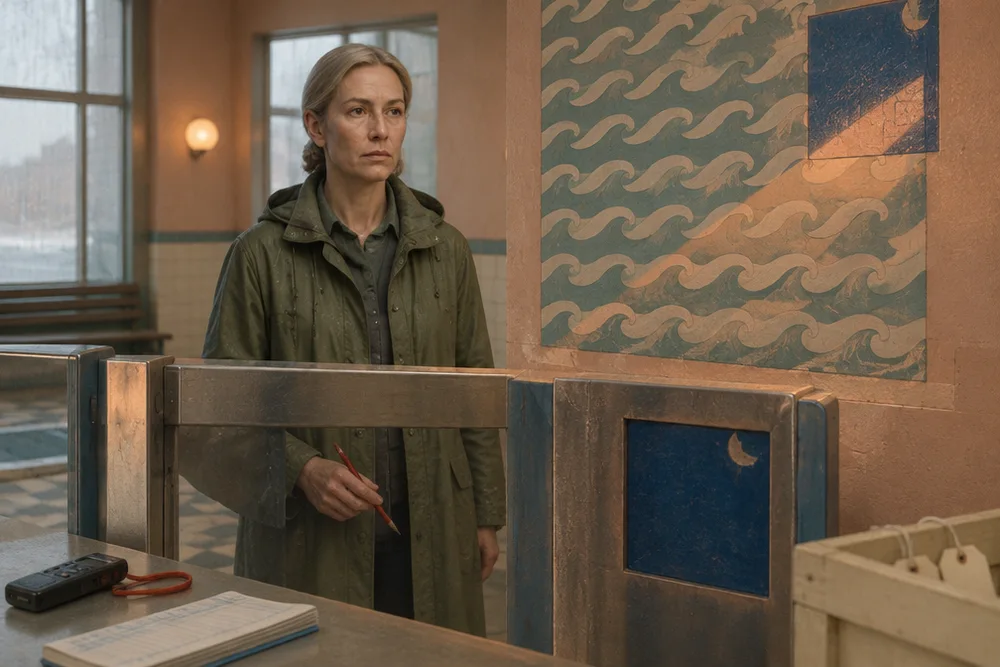
“Don’t keep that,” Ivo said. “It’ll turn to grit in your pocket.”
Mara opened her hand and let the fragment fall into the tray. “I wasn’t keeping it.”
He glanced at her palm. “All right.”
There was no softness in his voice, but neither was there judgment. He had learned to make a distinction between what could be saved and what was only evidence of what had been there. Mara was still learning that distinction.
When the first section finally lifted, it did not come away like a picture. It came away like a stubborn door: a little at a time, with Ivo supporting its weight and Mara watching the lower edge for a crack. They lowered it onto padding. The wave was cut in an awkward place, its painted motion divided between two separate boards.
Mara let out the breath she had been holding. “It looks wrong.”
“It’s not on the wall.”
“It looked right on the wall.”
“Then the wall was helping.” He checked the backing for movement and eased the section farther onto the bench. “A lot of things do.”
She started to answer, but boots sounded on the hall tiles. Tess Saye appeared behind the barrier in her moss raincoat, red pencil tucked into the seam of one hand. She waited until Mara met her gaze before speaking.
“I heard the row had divided,” Tess said. “Can I see the exposed edge?”
“From the hall side,” Mara replied, nodding at the marked access limits.
Tess stayed behind the barrier. Her eyes moved over the newly lifted section, then to the two dark lines where the hidden joins had been. “If you can establish that the break follows original construction, I can still consider purchasing fragments.”
“Consider?” Mara asked.
“The arrangement and authorship would have to hold. My collection is a study collection. I can’t buy a set of unrelated pieces and describe it as one intact work.”
Mara wiped her hands on her trousers. “Ada made the mural. That much holds.”
“She conceived it?” Tess asked. “Designed every row? Set every tile?”
The questions sounded tidy, like boxes on a form. Mara thought of the children reaching for the lower edge, of the wave she had known since she was small, of the blue square whose chip she had not yet asked anyone about. “I don’t know yet.”
Tess’s pencil appeared between her fingers. “If other people contributed, I need documentation. I’m not asking you to erase anyone. But I need to know what I’m acquiring.”