What the Tiles Remember
Page 190 of 220
Chapters
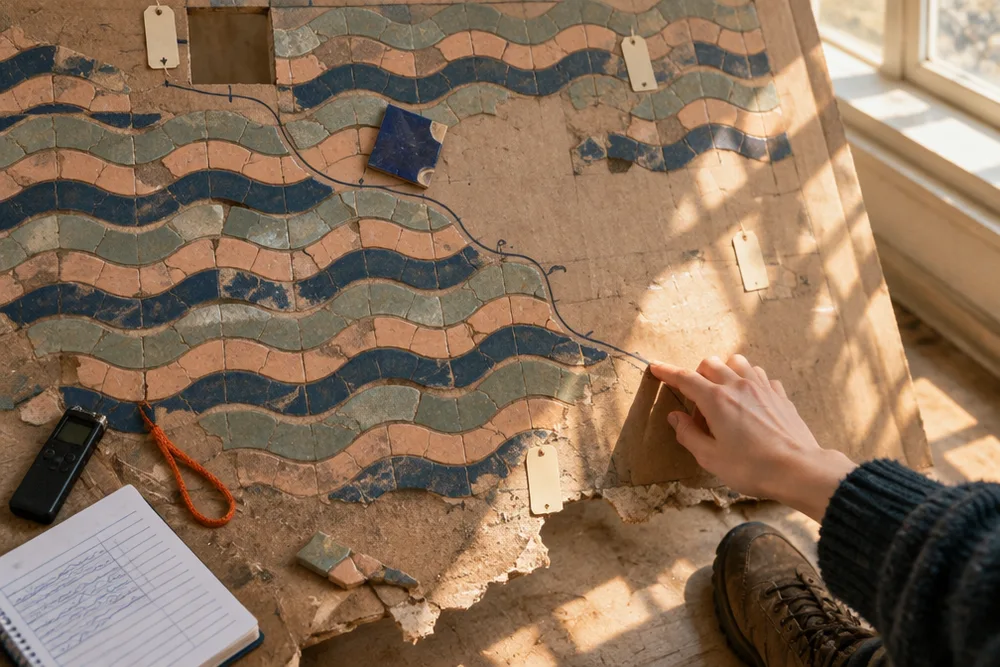
Mara bent close to the panel. The recovered tiles had been arranged according to the audio map and the tagged positions, not an old photograph. She could see where the wave crossed the little hooked line, and where her memory had once insisted on a continuous curve that the wall never held. She had learned that a blank could be a place someone was invited to fill, or a space worn away by time and damp. Their display would have both. If she painted one over, she would make the mural simpler than it had been.
“The opening stays unfilled,” she said. “And we leave the damaged bottom visible, with the support behind it.”
“That’s more honest,” Ivo said. “And safer than pretending the broken edge can carry itself.”
Perrin reopened the ruler. “I can approve a removable mount. I can’t approve a permanent reconstruction, and I can’t pay for the whole collection. You already know that, but I want it said plainly before anyone mistakes the panel for a promise.”
“It isn’t the whole collection,” Mara said. She heard the old urge in her voice—to apologize for what the library could not do, or to make the fragment stand for more than it was. She let the sentence rest instead. “It’s one section. People can come see it. The rest stays in storage for study and possible loans.”
Perrin wrote a note on the form. “Then the caption must say that. Not ‘the mural, saved.’ A panel from Warm Current, with the unrecovered lower band identified.” They paused, pen hovering. “And the display cannot block the returns lane. If someone with a trolley has to turn sideways, we move it.”
“Agreed,” Ivo said. He looked at the opening between the panel and the floor. “We can set it into the recess. It won’t stick into the bay.”
Mara followed Perrin’s glance toward the separate returns lane. She remembered the earlier mockup, when Ivo’s first footprint had blocked it and the reader with the trolley had been forced to turn. They had shifted the panel until the route was clear. There was no reason to make access a decorative promise either. It had to work in the ordinary flow of the library—books coming back, people coming through, nobody needing to ask permission to pass.
Perrin signed the allocation line and slid the form toward them. “This commits the display funds for one removable panel, conditional on the title paperwork and the paid installation quote. I can’t make the purchase claim disappear. That part is between you and Tess.”