What the Tiles Remember
Page 163 of 220
Chapters
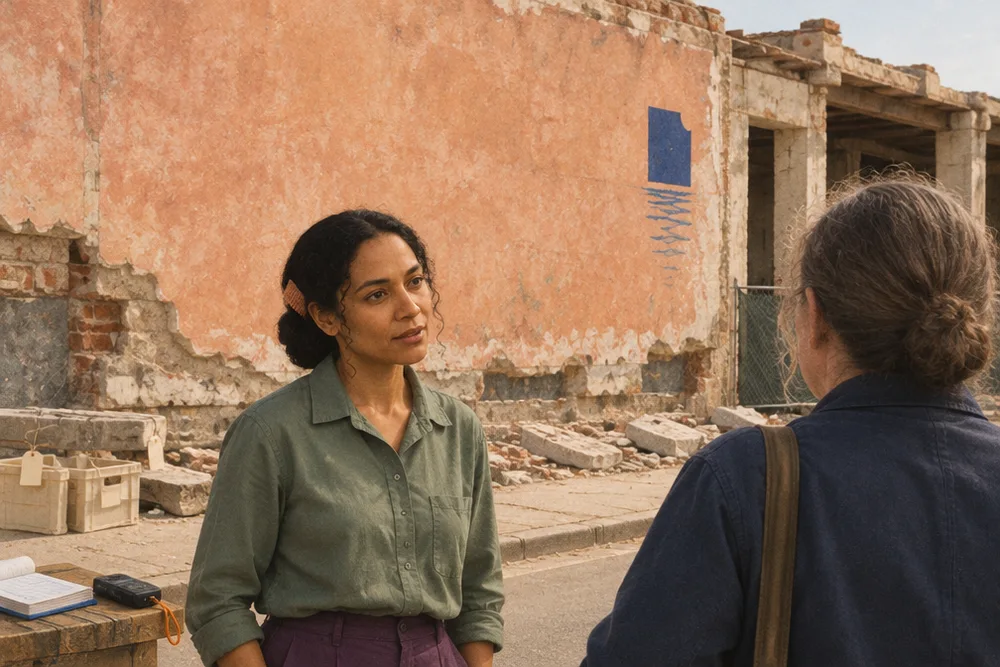
She had pictured this moment while the mural was still on the wall. In those pictures she had always been holding something: a tile, a tag, Ada’s receipt book. Now her hands were empty. She kept them in her pockets, her fingers curled around the edges of the recorder.
A woman approaching from the lower street slowed at the sight of her. She had a cloth shopping trolley and an old swimmer’s posture, one shoulder slightly set as if used to carrying weight. Mara recognized her from the baths, though she had not spoken to her in years.
“Mara Cazal?” the woman asked.
Mara turned. “Yes.”
“I’m Ruth Ellery,” the woman said. “I used to swim there before my shift. I heard they were taking the wall down.”
Mara knew the name after a second. Ruth had come in once to have a coat sleeve shortened, many years ago. “They’ve taken the mural down already. The building’s coming down now.”
Ruth looked beyond her toward the dust. “Did it survive?”
Mara could have said yes. The crates were in a dry depot. Most of the tiles had come away. The library had agreed to display a panel. Any of those sentences might have answered the question without answering it.
“Some of it,” she said. “Most of the pieces we could lift are safe. But the lowest band was too brittle. It powdered when we tried to move it. We recorded where it was, but there aren’t originals to put back.”
Ruth’s hand tightened on the trolley handle. “The whole bottom?”
“Not all of it. Some chips were recoverable. We put those in trays. The rest is lost.” Mara made herself keep her voice steady and exact. “We won’t be able to remake that edge from the original tiles.”
Ruth did not look away from the site. “Ada used to tell us that wall would outlast all of us.”
“She may have believed it.”
“I did.” Ruth’s gaze came back to Mara. “I went in there after night shifts. It was warm. You could wash, sit down, let your feet stop hurting. That wall was part of it.”
Mara felt the old impulse to offer something pretty: that Ada’s work was still here, that the pieces would live on, that the loss could be made smaller by calling the panel a continuation. The truth required less charm and more care.
“The public part will be in the library,” she said. “One panel, not the whole mural. It will include a place Ada left blank, and the broken lower edge will be visible. The other pieces are being stored for study and future loans.”