What the Tiles Remember
Page 100 of 220
Chapters
He turned back to the wall. She watched him set his feet and bend at the knees to listen for the difference between a tile held tight and one already loose. Outside, the lower street waited on its new drainage. At Hem & Turn, a stack of hospital uniforms would be waiting for her. At the depot, a single rack would be open only if they arrived on time.
The mural had to come down. The crate would not stack. She could not make either fact kinder by pretending they meant the same thing.
By the time they packed up, the hall had darkened. The peach glaze still held a little color where the last light reached it, but the unlit rows were turning the same muted shade as the mortar. Mara checked the tags against her notes and counted them aloud. Ivo checked her count without correcting her until she missed one.
“That’s four,” he said. “You’ve got five on the list.”
She scanned the bench. The missing tag had slipped beneath the kraft paper. “Found it.”
“Now it’s four.”
“You’re very strict.”
“You’re very tired.”
She drew a small line through the extra number. He was right. The work had not grown more manageable because she had named its parts. She was still going to meet Tess, still going to pay for the rack, still going to decide whether the sale could be released. But at least those were no longer one enormous choice disguised as a crate problem.
Ivo lifted the measured paper. “I’ll put this with the crate notes.”
“I’ll keep the recording.”
“Two records.”
“The paper can get wet.”
“The audio can get lost.”
“Then we keep both.”
He gave her a brief smile. “That’s what I was going to say.”
Mara switched off the hall light. The mural disappeared in sections, first the lower row, then the broad pale curl, then the cobalt square with its chipped crescent. She waited a moment in the doorway before she followed Ivo out. Nothing was complete, but the tags were counted, the rack was provisionally held, and Tess had agreed to meet when Mara was ready.
Tomorrow, the lift would continue. Today, she had stopped treating the saving of the wall as if it guaranteed a place to show it. She could preserve the pieces without deciding they all had to be displayed together. She could ask for room without asking anyone else to surrender theirs.
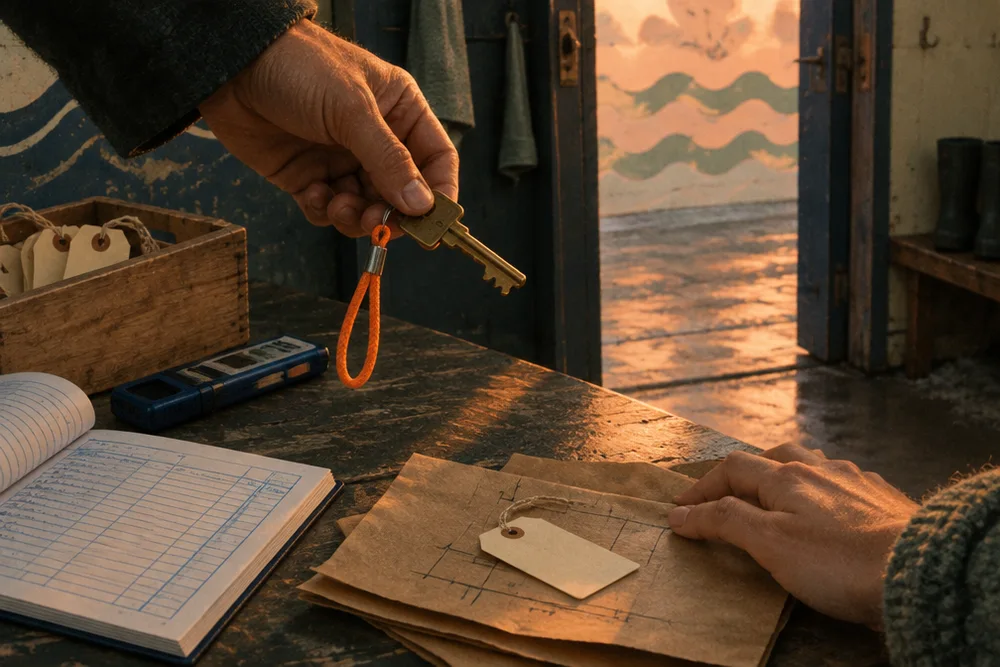
Outside, the air smelled faintly of wet pavement. Ivo locked the hall door and handed her the key for the night. “Friday,” he said.
“Friday,” she answered, and closed her fingers around it.