What the Ledger Left Blank
Chapter 9 · Two Places at Table
Page 83 of 301
Chapters
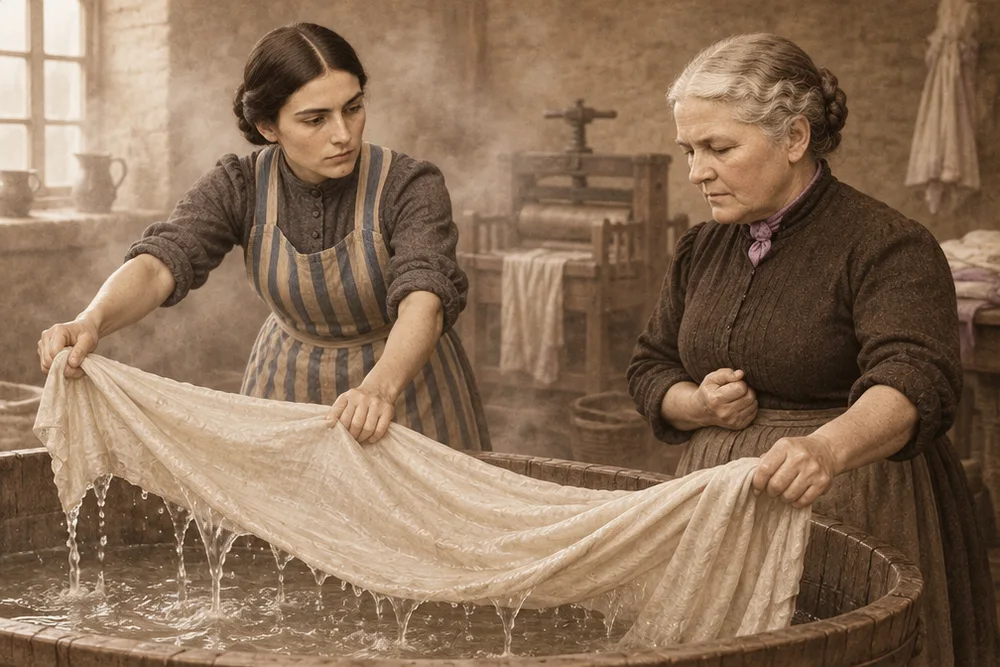
The first sign that Keziah could not finish the load was the silence at the wringer. Its rollers turned with a steady wooden complaint, and the boiler breathed behind the wall, but no one called for another basket. Elspeth looked up from the sorted shirts. Keziah stood at the tub with her right hand curled against her apron, water dripping from her left wrist. A sheet sagged between them, half lifted, its wet weight drawing her shoulder down.
“Leave it,” Keziah said, before Elspeth had moved. Her square face had gone the color of the flour sacks stacked by the rear door. The orchid kerchief at her throat was dark with steam. “I can manage.”
She tried. Her fingers closed on the sheet and did not hold. It slid back into the tub with a slap that sent water over the rim and across her shoes. Bess, at the ironing board, turned, then looked away as if she had not seen. Her red braid was tied close against the heat; the knobby elbows under her checked sleeves had gone rigid.
Elspeth wiped her hands on her striped apron. “I’ll take that side.”
“You’ve your own table.”
“The shirts can wait.”
Keziah’s gaze held on her, measuring whether this was pity or a practical offer. Elspeth had spent six years learning to move at another person’s need without seeming to notice it. She knew the danger of being useful: a task could become an expectation before one had agreed to it. But the sheet was soaking in dirty water, and Keziah’s right hand trembled where it pressed against her bodice.
Elspeth went to the tub. “Show me where you want the fold.”
For a moment Keziah said nothing. Then she shifted her planted heels apart and gave Elspeth the far edge. “Keep your fingers clear of the rim.”
They lifted together. The sheet came up reluctantly, swollen with water, and Elspeth felt its weight run from her arms into her back. Keziah gave the directions—fold, turn, feed it—without making a show of the hand she kept tucked against herself. At the wringer’s mouth, Elspeth paused, remembering how a cuff could catch and how quickly a roller took more than cloth. Keziah tapped the wooden guard with her knuckles.
“There. Not close enough to lose a finger.”
The sheet passed through, flattened and streaming into the basket on the other side. They repeated the work with the next piece. By the third, Elspeth’s shoulders had begun to burn. Keziah’s instructions were spare, but exact; she knew how the cloth would pull before it did. Elspeth followed, and the stack rose slowly, each piece laid square over the last.