The Weight of Blank Paper
Page 66 of 246
Chapters
At the threshold Kester stopped. “Pella.”
She looked over her shoulder.
“If the old punch touched that sheet, it doesn’t tell us when.”
“I know.”
“And it doesn’t tell us who.”
“I know that too.”
He believed she did. He believed she was already carrying the next question, though the answer might implicate someone she loved. His own part was less complicated, but not less uncomfortable. He had vouched for the count without seeing the ballots. He could not undo that by making his new statement sound cleaner than the old act. He could only say where his certainty had ended.
“Then we wait for the examination,” he said.
“And the archive.”
“And the ledger, if there is one.”
Pella’s face changed almost imperceptibly at the word. Kester knew nothing of her mother’s records or what they might contain. He had only seen how she held herself: knees unlocked, chin forward, neither retreating nor leaning on him for the answer. He left the subject alone.
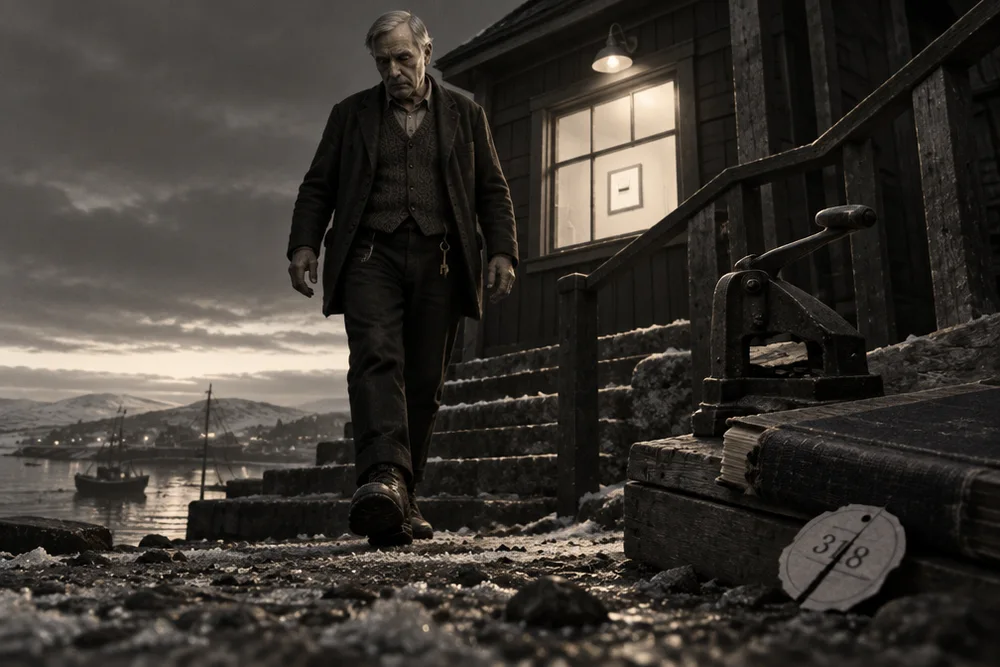
Outside, the salt air pressed against his eyes. Down the slope, house lights came on one by one. The village sat above the harbor, its windows at different heights on the steep ground, each marking someone’s evening separate from the trust’s accounts and the ballot’s neat crescent. From the landing came the call of a crewman securing a line.
Kester walked carefully. The stone steps had a wet shine. He could hear the terminal door close behind him, then the click of a lock. The next ferry had not been canceled; the island was not cut off. Still, the crossing’s regularity could make a person forget the work that held it together. A schedule did not renew itself. Someone had to count passengers, check weather, keep records, and admit when a number did not add up.
His signed statement was now in Devra’s case. It might help show that the old die had touched a ballot presented as counted stock. It could not explain the second seal, the missing originals, or the unanimous result. Those remained ahead, lodged in places he could not reach by memory alone.
At the bend above the harbor he looked back once. The terminal window was a pale square in the dark, and the framed ballot was a smaller pale shape inside it. Kester turned toward the village and kept going.