The Weight of Blank Paper
Chapter 13 · Keys on the Evidence Rail
Page 153 of 246
Chapters
The Sill Room had been built for nets before it was made to hear complaints. Its rafters were low and dark with old salt; drying racks stood along the walls, their crossbars cleared for the hearing and marked with paper labels. The room filled from the floor up. Tenants from the icehouse took the benches nearest the door, hill trustees clustered under a window, and the poll staff sat at a long table with their hands arranged carefully around their documents. Pella stayed standing until she could see the hatch diagram pinned to the evidence rail.
Orrin Venn stood with one shoulder toward the room, a heavy man who seemed to lean back even when he was still. His meeting corduroy was clean, his jaw set. “The terminal was closed,” he said. “Maren held the keys. I’ve heard the same implication all morning, but no one has shown how a packet could have been moved without her knowledge.”
Maren sat at the end of the witnesses’ table, upright, toes turned out beneath her chair. Her striped sleeves showed under the dark work smock. She did not look at Pella. The ledger was in Devra Sile’s flat document case, not in either woman’s hands. Since she had surrendered it, Maren had spoken to Pella only about where to sit and when to come in.
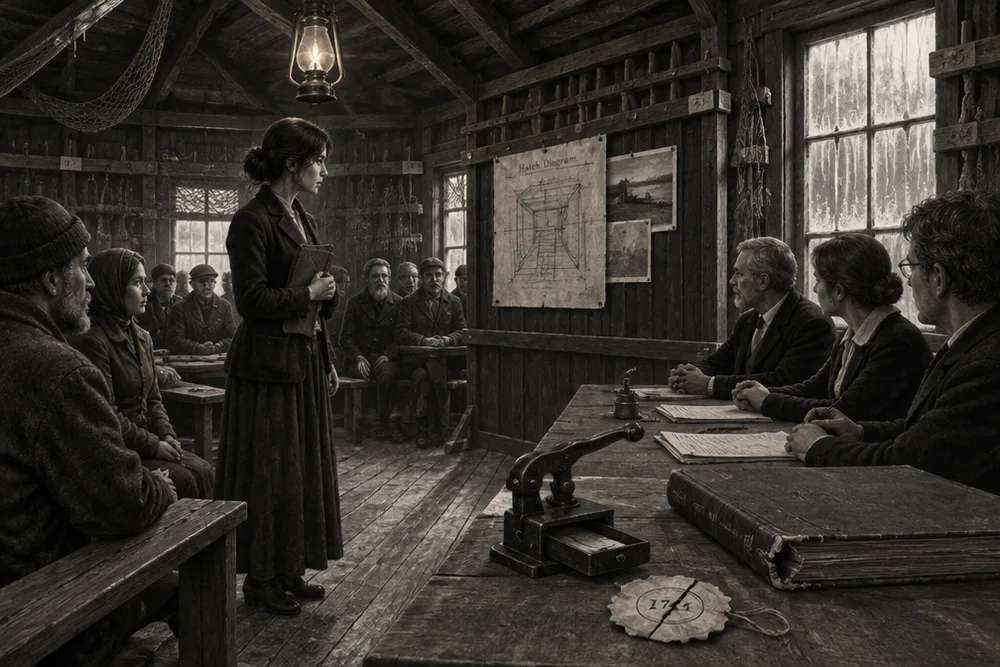
Devra rose. Her raincoat hem split at the sides when she stepped around the table. “We are not here to decide what anyone knew from a drawing,” she said. “We are here to establish the route of the packet and the punch as far as the records and witnesses allow.” She nodded toward Pella. “Show us what you observed. Don’t ask the room to infer more than it can.”
Pella took the diagram from the rail. It was a copy of the terminal floor plan, showing the public ticket hall, the staff hatch, the tally window and the tide stair. The hatch was a narrow rectangle in the wall behind the counter. From the public door, the counter blocked it. From the slip, a person approaching the staff side could reach it without crossing the ticket hall.
“This is the view from the entrance,” she said. She laid a straightedge along the pencilled line. “You can see the counter. You cannot see the hatch or the space behind it. The front door can stay shut while someone passes something through here.” She moved the straightedge to the line marked slip. “From the slip, you can come up the service stair and reach the hatch. That stair is outside the public hall.”