The Weight of Blank Paper
Page 2 of 246
Chapters
Maren’s ticket fluttered in the draft from the open doors. “Last chance,” she said.
Pella looked past her at the ferry, then at the punch. “Go ahead.”
Maren held on to the ticket a moment longer. Her mouth tightened, but she did not argue. She stepped onto the ramp alone, carrying no bag. Pella watched her cross into the ferry’s lit interior, then turned back to the counter. The clerk was already peeling the tag from the stool beside it.
Pella carried the punch to the tally window, where the counter narrowed and the wood had been polished smooth by generations of hands. From there she could see Maren through the ferry windows, upright among passengers leaning over their bags. The vessel’s engine shuddered, then settled into a low growl. Its departure was not the same as the end of ferry service, she reminded herself. The subsidy expired at midnight. The boat would make this last scheduled run whether or not the harbor was sold.
She set the punch down and opened her tool roll. The lever had no give at all. The return spring had failed months before its retirement, and the trust had replaced it with a new die whose crescent-shaped cut was still used to validate ballots. Pella knew the broad history. She had not been here for the referendum six weeks ago, and she had not asked her mother how the vote went. The official result, unanimous, had arrived on the mainland as a line in a local notice: 143–0 in favor of selling the harbor.
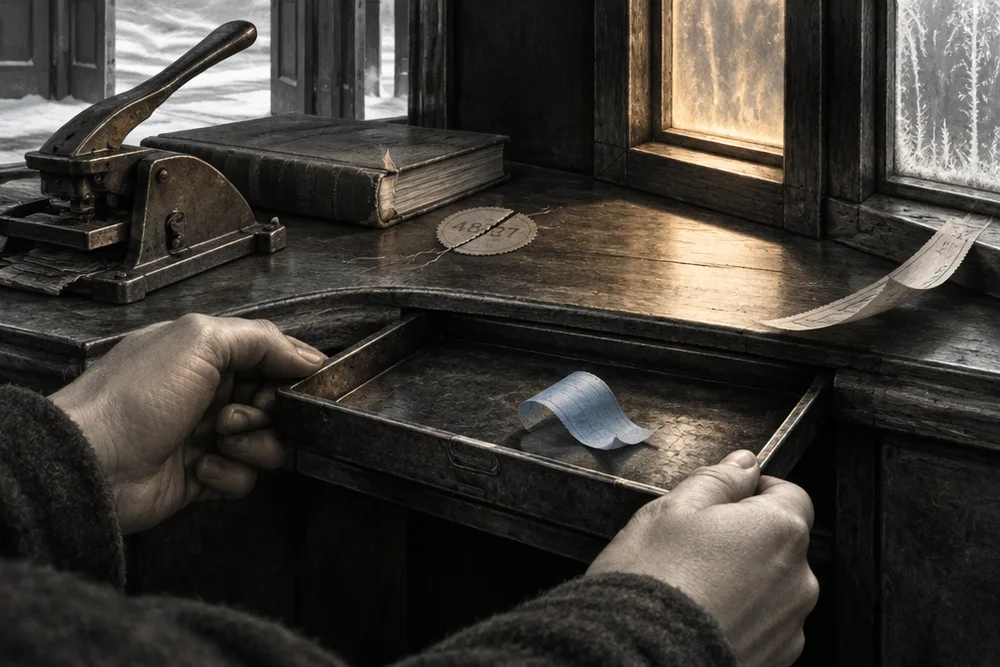
She felt for the catch tray’s catch. It resisted. She eased the hinge with a narrow driver, careful not to force the old iron. There was a snag inside, something caught in the seam. Pella angled the tool toward the window. A thin curl of paper came loose, pale blue beneath the dust.
She stopped moving.
The clipping was small, no bigger than a fingernail, and had a clean crescent cut along one edge. Its other edge was torn rather than trimmed. Pella did not brush away the rust or pull at the tray. She laid her driver down and looked at the paper without touching it again. On the ballot stock, blue would have been obvious. In the terminal’s gray light it looked almost white.
“You done with that?” the clerk called from behind her.
“No.” Pella lifted both hands away from the punch. “I need someone to see this before I clear anything else.”
“You bought it.”
“I did.”