The Night the Floor Plan Wept
Chapter 9 · The Ring Finger’s Shadow
Page 92 of 232
Chapters
Nell stood beside the records-room table with her mustard jacket unzipped and her black boots planted wide, as if the hospital might try to move her without permission. The complaint lay between her and Celia, its folded corners softened by years of handling. Celia had set it beside the two dispatch reports and the linen plan. She had not put the papers in a folder. Nothing was to be hidden from anything else tonight; she had learned that much, though she could not say she understood why the walls seemed to care.
“I want to hear him,” Nell said. She didn’t look at the reports when she spoke. “Before we leave. If he’s there.”
Celia’s hand rested on the complaint’s upper edge. Beneath the old typewritten lines, a blue pencil had underlined the phrase room officially vacant. It was the phrase that had led Nell to the hospital’s records years ago, and the obsolete location field Celia had removed in the migration was what had severed the complaint from Ivo’s chart. She had admitted that. Nell had not forgiven her, and Celia had not asked her to.
“I can take you to the ramp door,” Celia said. “I can’t promise who you’ll hear.”
“I didn’t ask for a promise.” Nell’s mouth tightened. “I asked to hear him.”
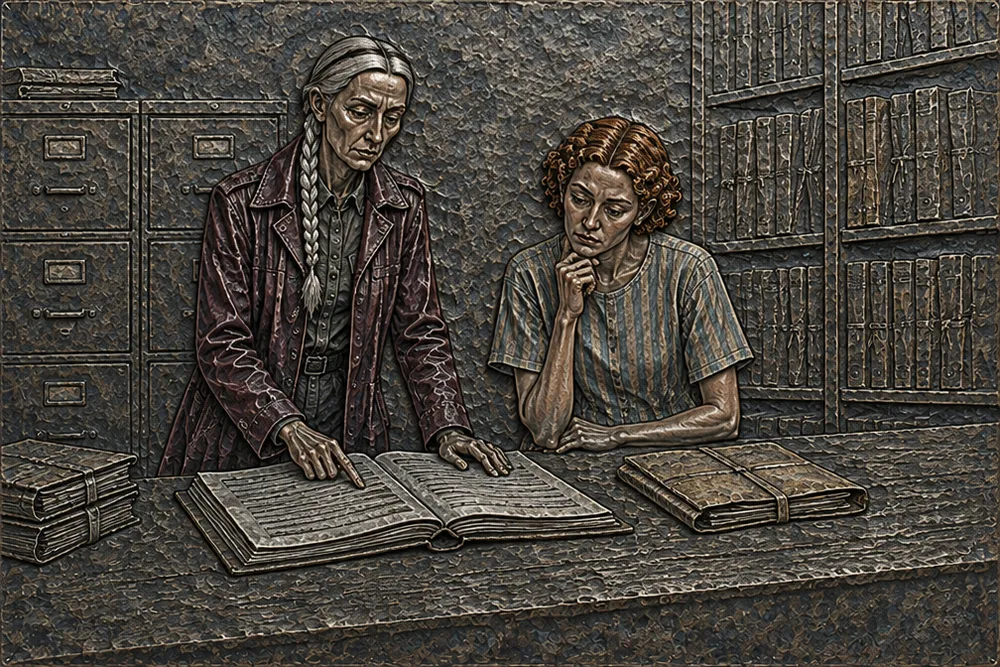
Behind the wall, something shifted with the slow, scraping pressure of a chair dragged across a floor. Celia saw Nell’s eyes flick toward it, then back to her. On the table, both original reports remained open beneath glass weights. Report A, with its list of six patients loaded for transport up the west ramp. Report B, recording the same six still inside as the east landing was sealed. Each carried Ada Venn’s initials. The weigh ticket supported one account; a recorded callback supported the other. Neither paper had yielded to the other.
“The door’s on the west ramp,” Celia said. “It might not stay where it is.”
Nell drew a breath through her nose. “Then we go now.”
Celia lifted the complaint and tucked it under her arm. She put no other paper away. Together they left the records room, walking toward the ramp while the hospital’s fluorescent lights buzzed overhead, one fixture at a time, as though counting them.
The west ramp door had narrowed since Celia last stood before it. Its jamb pinched inward at the bottom, leaving a wedge of darkness no wider than a person’s shoulder. The edge looked less built than pressed, plaster compressed around a rectangular absence. A cold draft came through it, carrying wet concrete, river mud, and the sharp medicinal smell that had clung to old wards.