The Night the Floor Plan Wept
Chapter 6 · The Wall’s Traveling Dent
Page 56 of 232
Chapters
Celia put Report A in the dispatch cabinet for safekeeping, though the phrase had begun to sound like a diagnosis. The cabinet stood against the records room’s north wall, a steel unit with shallow drawers and a lock whose key had been taped beneath the lip for twenty-one years. She slid the report into the drawer marked NIGHT DISPATCH, between a stack of blank call sheets and a directory of extensions that no longer existed. The paper was dry. Its fold lines had softened from handling, but the ink held: six patients loaded, west ramp, ambulance departed at 02:13. She shut the drawer and turned the key. The small click seemed, for one breath, an ordinary sound.
Across the room the new doorway at the west ramp remained open. From where Celia stood she could see only a strip of the corridor and the white edge of a bed beyond it, the shape of a person sitting upright. The door had appeared when she bracketed the conflicting locations in the reports. She had not touched it since. At the east landing, the other opening showed six beds under a low, water-marked ceiling. Their occupants had watched her with expressions she could not sort into hope or accusation. Her pencil lay on the desk beside the two originals’ empty spaces. She had separated the reports, but separation had not made either account safer.
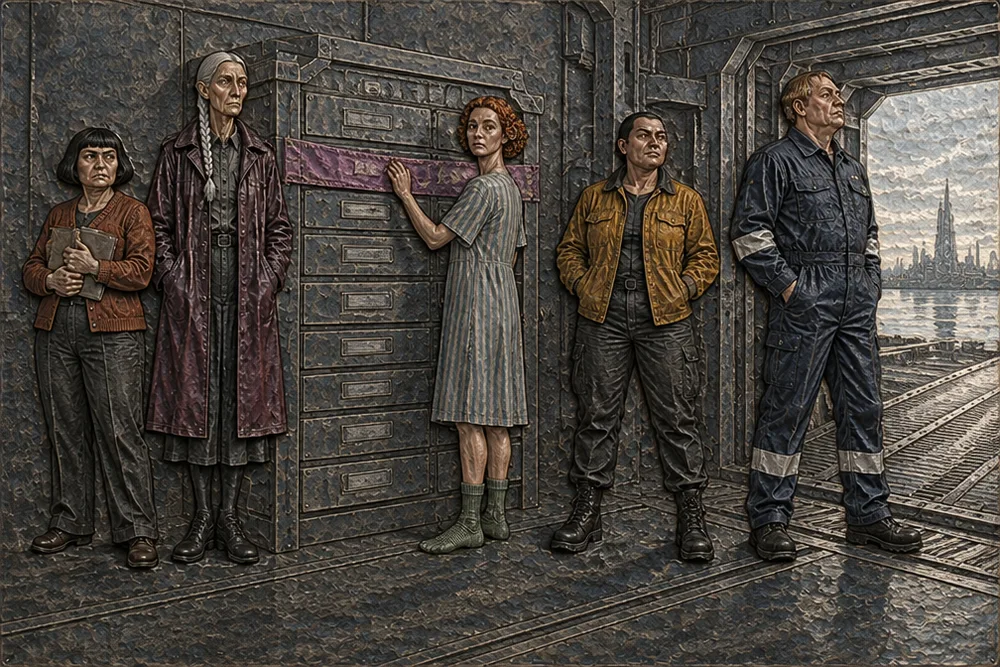
A hard little snap sounded inside the cabinet. Celia faced it. The lock was still turned; the key had not moved. A white paper strip pushed through the seam beneath the drawer, inch by inch, as if fed from the dark interior. On it, in faded purple ink, was a rectangular stamp: DISPOSITION—TRANSFERRED. The cabinet had no business possessing a disposition stamp. The mark belonged to the old inventory system, the one she had learned to recognize on cartons sent away, and on records declared complete. She pulled at the drawer. It would not open. The paper strip continued to emerge, dragging across the floor toward the west door.
The strip stopped halfway to the threshold. Its stamped edge lifted, then adhered to the corridor wall. The purple letters bled into the plaster, each one spreading as if the wall had been damp before the paper touched it. Celia stepped toward the cabinet and felt the pressure of the two reports’ absence, like a missing weight on a shelf. She had put A away for safekeeping. The building had taken the act as an instruction. Somewhere beyond the wall, something answered with a slow, deliberate scrape. She reached for the key again, already understanding that a locked drawer was not the same thing as a protected record.