The Night the Floor Plan Wept
Page 49 of 232
Chapters
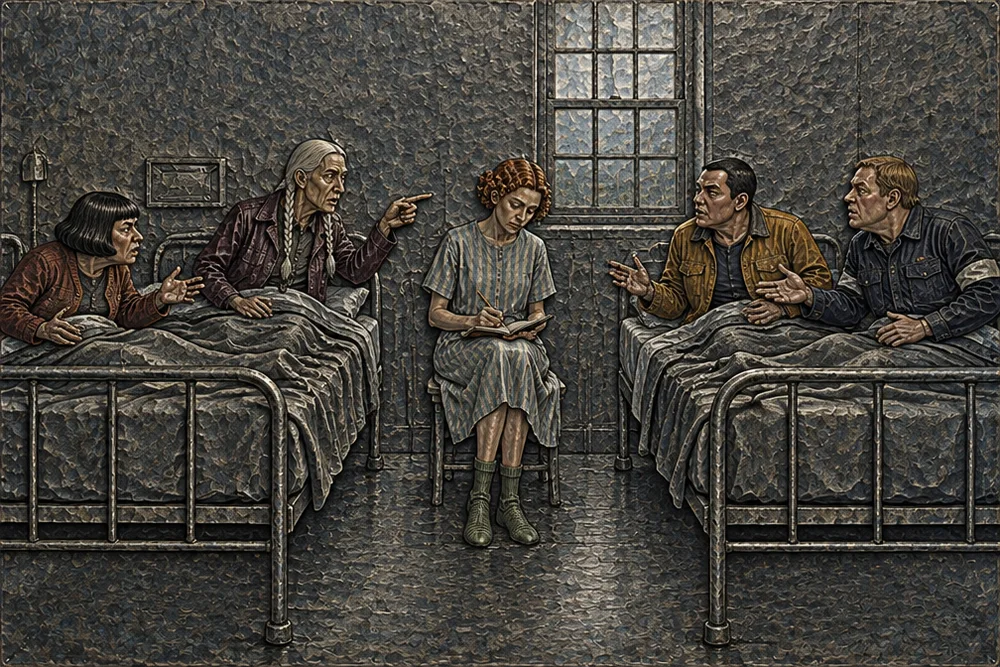
It was the most honest answer she had. The room did not close. The woman did not thank her. The six beds remained under the flat white light. Celia returned her attention to the table and laid each report on a separate section of bare wood, leaving enough space between them that neither could be mistaken for an attachment to the other.
Behind her, the patient in the far bed began to speak again. His words were low and halting, and Celia turned to listen without picking up her pencil.
“There was a knock,” the man said. “Before the door opened.”
The woman in the nearest bed shook her head. “There wasn’t.”
“I heard it.”
“You heard the landing.”
“No. Three times.” He lifted his hand from the blanket, fingers crooked as though they held a small object. “Here. On the wall.”
Celia listened. No knock came. The east room held its unnatural brightness; the corridor behind her was dull and close. In the gap between the reports, a dust mote drifted down onto the wood. It settled between the two originals and stayed there.
“What happened after the knock?” she asked.
The man lowered his hand. “I don’t know. They told us to wait.”
“Who told you?”
He looked toward the far end of the room. “The ones with the list.”
Another patient said, “There was no list.”
“You had one,” the woman replied. “You made us line up.”
“You were the one who said to stay in bed.”
Their memories broke apart into small, sharply stated pieces. Celia did not try to combine them. She did not ask which of them was right. She knew what a listener could do to testimony without meaning to: arrange it, smooth over differences, supply the missing sequence because a sequence felt like understanding. A record could preserve a contradiction without turning the witnesses into enemies, and without deciding that one of them had invented the gap.
She pulled a clean sheet from the stack of inventory forms. At the top, she wrote the date and time, then the words: East doorway, six beds observed. She paused over “observed.” It described what she saw, not what she knew the room to be. Under it, she wrote: Patients gave differing accounts of a woman’s return and of instructions received. No identification established. She left the margin open. There was no need to attach the notes to either dispatch report, or to call them corroboration, or to place them under the heading of discharge.