The Night the Floor Plan Wept
Page 44 of 232
Chapters
“What is that?” Celia whispered.
No one answered. The west ramp door gave another hollow creak. The dent remained on the page, bulging the paper from beneath. Then it flowed back into the wall in a slow, deliberate retreat, dragging itself away from the report and along the plaster toward the floor.
The paper settled flat.
Celia took a half-step away from the table. The dent moved with it, still following the exact route of her bracket, not her body. It had gone back to the wall, but its course remained visible in the paint as a shallow, wavering groove. It paused near the skirting board and turned upward again, as though retracing the line from its beginning.
A single bead of water formed on the wall and slid down, leaving a dark track.
“Don’t mark it,” the woman in the bed said.
Celia looked at her. “I didn’t.”
“Not this time,” the woman replied.
Celia’s tongue felt dry. “You saw it before?”
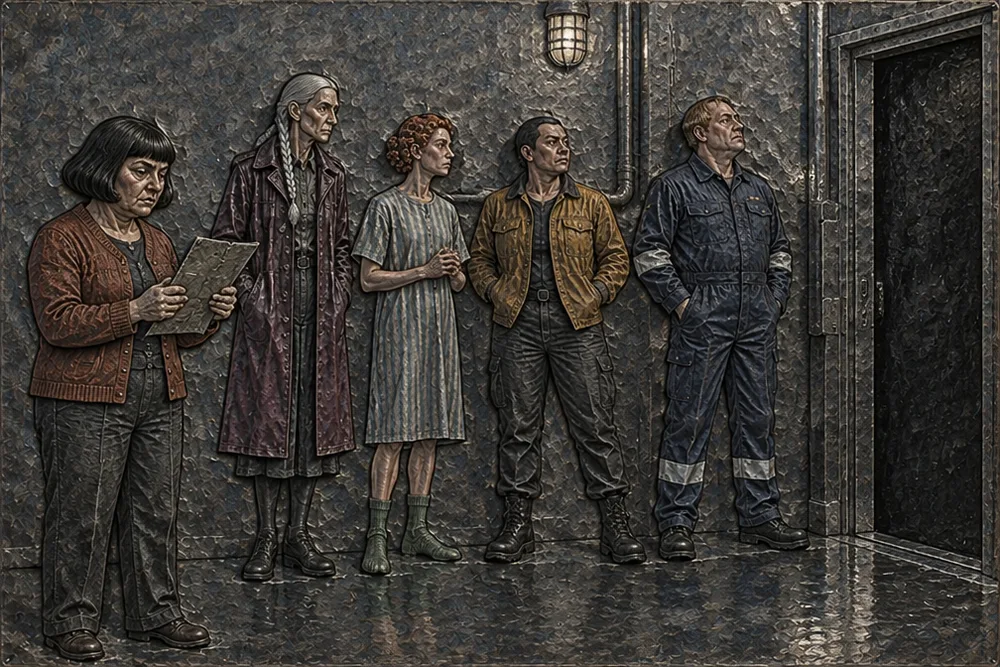
The woman did not answer at once. She looked toward the west door, then the east, as though checking which route was available. The other patients watched her. Their faces seemed older and younger by turns, features shifting with the weak light, though none of them moved. Celia thought of Ivo’s name on the complaint, the chart that had lost its location field, and the space where a person might be called missing because the record had been made unable to find him.
“It came after the writing,” the woman said at last. “It checked what she wrote.”
“Who?”
“You.”
Celia glanced at the report. “I’m not the one who made these reports.”
“You put the line there.”
The statement was true in the narrowest possible sense. Celia had drawn the bracket. She had not created the contradictory entries, or the patients’ room, or the dent. But she had given the contradiction a visible shape. The building had answered that shape with doors. Her pencil had not merely recorded a disagreement; it had made a route for it.
She picked up the report by its corners, careful not to touch the bracket. The paper was cool and damp. Under the fluorescent glare, its fibers shone faintly, as if a mist had settled across them. There was no water pooled on the tabletop. No visible mark where the dent had pressed, either. Only Celia’s graphite remained beside the two incompatible lines.
“Are you still there?” a voice called from the west ramp doorway.