The Night the Floor Plan Wept
Page 176 of 232
Chapters
The paper bucked beneath her skin. For an instant she felt the outline of a letter forming, not yet legible. The pressure was cold and precise. The presence was waiting for a mark to follow.
“You need to write,” Ada said. “Not what they want. What you know.”
Celia took her hand away. The new sheet showed a dent in its center, the beginning of a stroke. Her ballpoint hovered over it. She had spent years believing that good records were clean records: no orphan fields, no uncertain labels, no unfinished task left to catch at the next clerk’s sleeve. A clean entry kept the work moving. It also made a missing person disappear with the same efficient click as an obsolete address.
She wrote her name at the top: Celia Thorndray. Then the date. The pen dragged where the pressure had warped the paper, but the ink took.
“Write the action,” Nell said. Her voice had sharpened. “Not the apology.”
Celia nodded once. She began: Three years ago, during migration of the Briar Reach Hospital records, I removed the obsolete location field from the index. She paused, hearing the room’s tiny noises: rain ticking somewhere in the building, a distant pipe knocking, Ivo’s breath, her own pen scraping.
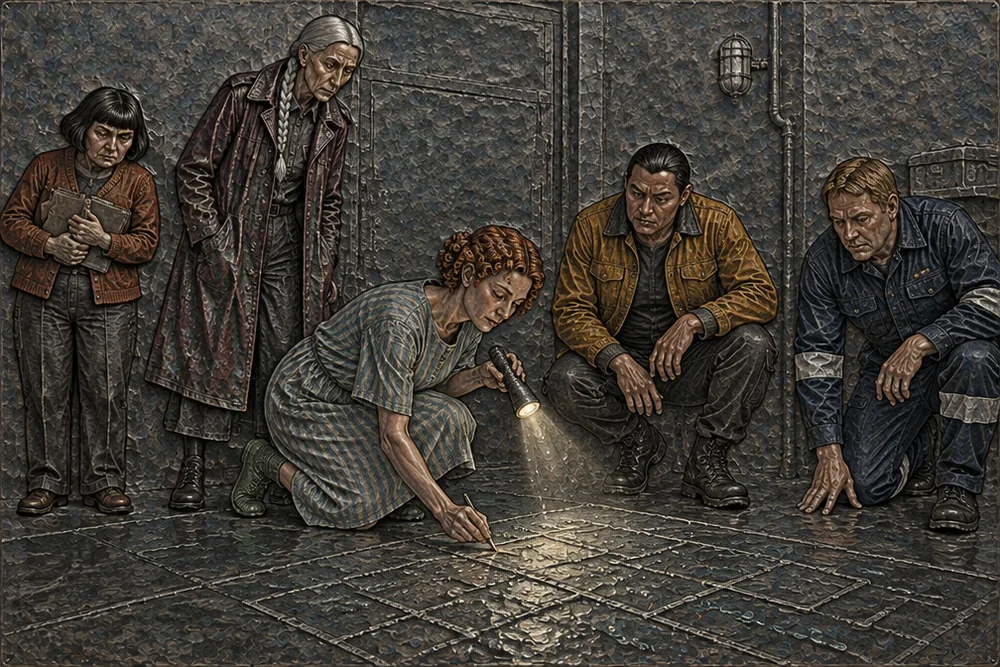
The dent had not moved. Its pressure rested under her writing, as though the page were a door that might open if she gave it the right line.
She continued: I did not check the affected complaint records against the paper index before removing the field. I did not verify whether unresolved cases relied on the location link. I marked the migration complete without confirming that every complaint remained connected to its patient chart.
A bead of water formed at the plan’s edge and rolled toward her hand. The linen dipped under it, tracing the old outline of Room 17. Behind the wall, something crossed the plaster from the authorization to the fresh sheet, following Celia’s sentences.
She wrote that Nell Saye had filed a complaint concerning her brother, Ivo Saye, and that the migration severed the link between the complaint and his chart. She did not write that Ivo had been lost because of her. She could not know what had happened to him in the old hospital, or whether the missing link had altered any decision made on that night. A record could hold injury without claiming more than its maker knew.
The words crowded the lines. Her hand cramped around the pen. She went on: The effect of my action was to make the complaint harder to retrieve and to leave the connection between Nell’s report and Ivo’s case absent from the modern index. I did not discover this until Nell brought the original complaint to the final inventory.