The Night the Floor Plan Wept
Page 161 of 232
Chapters
“We need to know what the route is,” Nell said. “Not what you hope it is. Not what the plan says. What it is.”
Celia nodded. “The only way to know is to test the wall without declaring what we’ll find.”
“How?”
“Carefully.”
Nell gave a short, humorless breath. “Carefully is not a tool.”
Celia looked at the wall again. The survey jacket had held the linen plan; its folds preserved the building’s older arrangement. Somewhere in it there might be a notation for the service passage, a symbol for a fire door, a reason the corridor had been sealed. But the jacket was on the lower records floor with the original dispatch bundles and the annotations that had opened the west and east doors. Returning there was impossible, and trying to reconstruct its contents from memory would only make a second plan, one that belonged to her.
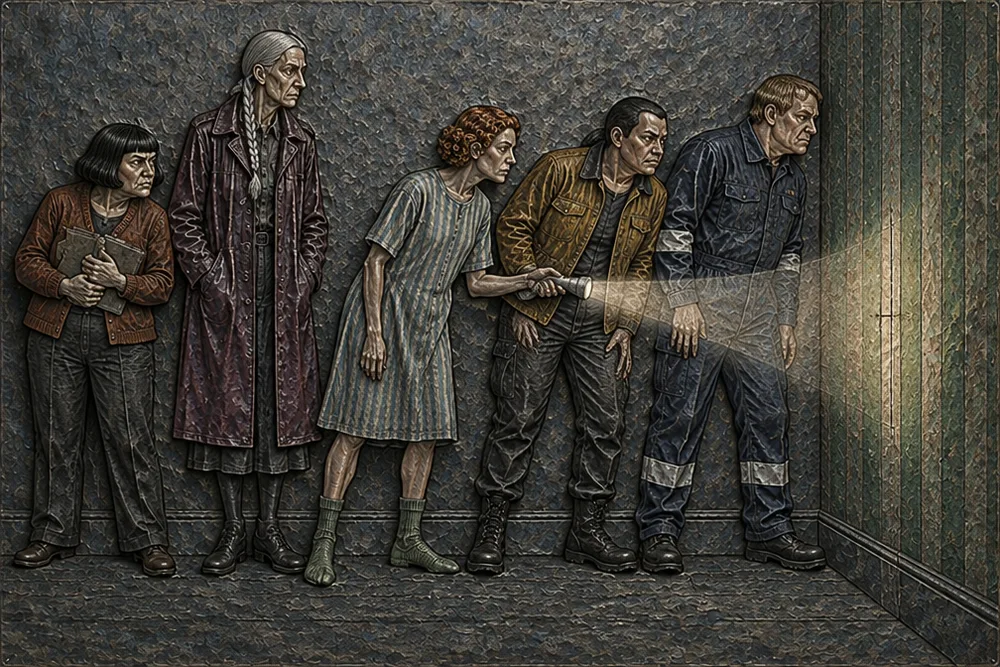
The raised corridor on the linen did not include measurements. Its proportions were approximate. There was no scale key, no legend for door swings. The passage’s location, however, aligned with a section of wall that ran behind the landing. If there was a former service corridor, the wall ought to be narrower than the load-bearing wall around it. That was a physical question, not a historical conclusion. Celia took the brass end of her flashlight and tapped along the plaster, not hard enough to break it.
The first stretch gave a solid, uniform answer. At the green stripe, the sound changed. It became hollow and faintly resonant, with a vibration that traveled into her wrist. She tapped again, at a different height. The same thin response. Beneath the green paint, a seam ran vertically from the handrail to the ceiling. It was too straight to be a natural crack, but there was no visible gap.
“There,” Celia said. “A seam, and a hollow space behind it. That doesn’t prove it goes to the dock. It does mean there may be a passage.”
Nell shifted closer, eyes fixed on the line. “And the door?”
Celia did not answer. She aimed the flashlight so its beam raked across the plaster, searching for a raised edge. The seam took the light without revealing a latch.
She ran the beam from floor to ceiling. At the top, the seam met a shallow horizontal ridge under the molding. At the bottom, it disappeared behind the metal guard that protected the wall’s lower edge. There was no handle, no hinge, no place to put a hand. The wall bore no sign of the old passage’s existence except that it sounded different when tapped.