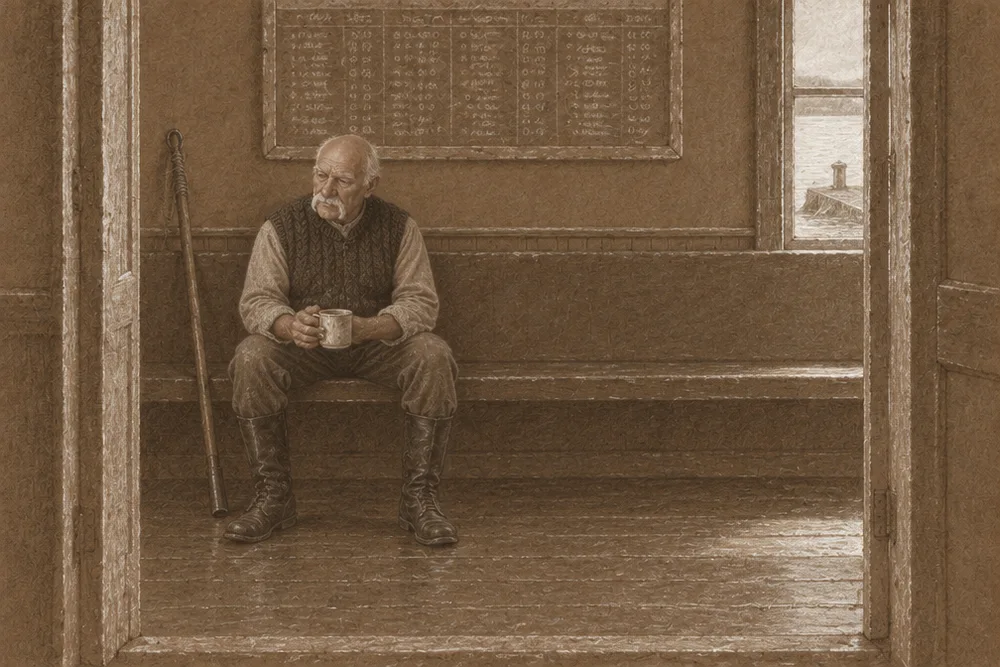
The Names Beneath the Soundings
Page 52 of 266
Chapters
From that room he could see only a slice of the river and the corner of the west-bank slipway. Ysolda had gone out to the yard with her log. Bleddyn remained in the office. The people who would decide what counted as a clean survey were not in the room yet, but already their judgment was among them: in the unapproved chart, in the form he had signed, in the years when no one had asked him for an anniversary reading because he had never offered one.
A boy came in carrying two mugs of tea and set one on the bench beside Gethin. It was the clerk’s son, home from school, with a scarf knotted loosely at his throat. He looked at the coil of line.
“Does that really measure the bottom?” he asked.
“It measures how much line goes down before the weight touches something.”
“If the water moves it?”
“Then you have to know how it’s moving.”
The boy considered this. “So you can get it wrong.”
“Yes.”
“Even if you’ve done it before?”
Gethin looked at him. “Especially if you think doing it before means you can’t be wrong.”
The boy took that in, picked up the empty tray, and left. Gethin held the tea between his palms. It was too hot to drink, and the warmth made his fingers ache. The river beyond the glass had begun to lift with the flood. A line of cross-ripples traveled against the ferry’s forward motion, the set upriver showing itself where the hull cut through.
He thought of the three apprentices, not as dates now, but as people whose names had existed before he reduced them to a pattern. He would have to say those names aloud in the review, and he would have to say what he had done. He could not control what the families chose to do with that account, or whether they believed him, or whether anyone believed a man who had kept evidence in a notebook until another person found it.
A shadow fell across the glass. The authority’s representative had arrived, carrying a flat document case. The clerk called Gethin’s name. He stood, slow and unsteady, and picked up the line. Whatever came next, he would not leave it folded on a slipway for someone else to interpret.