The Names Beneath the Soundings
Chapter 17 · Names on the Rail
Page 161 of 266
Chapters
Nia had borrowed the back room of the chapel hall because it had a long table and no windows facing the yard. She set three chairs on each side, then moved one away from the end. “Nobody needs to sit opposite the others like they’re in court,” she said. Her striped jersey showed beneath her bib overalls; the dark shave at her temple was still damp from the rain. “And nobody’s being asked to agree.”
Ysolda came in carrying a shoebox. Inside were a folded survey chart, a wooden ferry model, and a square of slate she had cut to the scale of the channel. The chart’s red exclusion mark looked almost theatrical under the hall’s hard lights. She put it down carefully, keeping the marked ridge toward herself. She had learned that a line on paper could look like certainty even when it was only the limit of what anyone had measured.
The relatives arrived in twos and separately. Mrs. Vale, whose son had died twelve years ago, wore a wool hat indoors and kept both hands around a paper cup. A man called Owen brought his sister, who had been engaged to one of the apprentices. The third family sent only an aunt, Gwenora Madoc, who asked at the door whether anyone intended to take photographs. Nia told her no. Gwenora looked at Ysolda until Ysolda said it too.
Mair came last. She stopped just inside, her belted coat buttoned to the throat, silver braid tucked close against her head. Ysolda had expected her mother to sit apart, but Mair took the chair nearest the door. She had brought a narrow folder, held closed beneath one hand. Neither of them greeted the other beyond a brief nod.
Nia waited until the cups were on the table and the door shut. “We can stop whenever anyone wants,” she said. “This isn’t a statement for the papers. It’s a chance to see what the survey says, and what it doesn’t.”
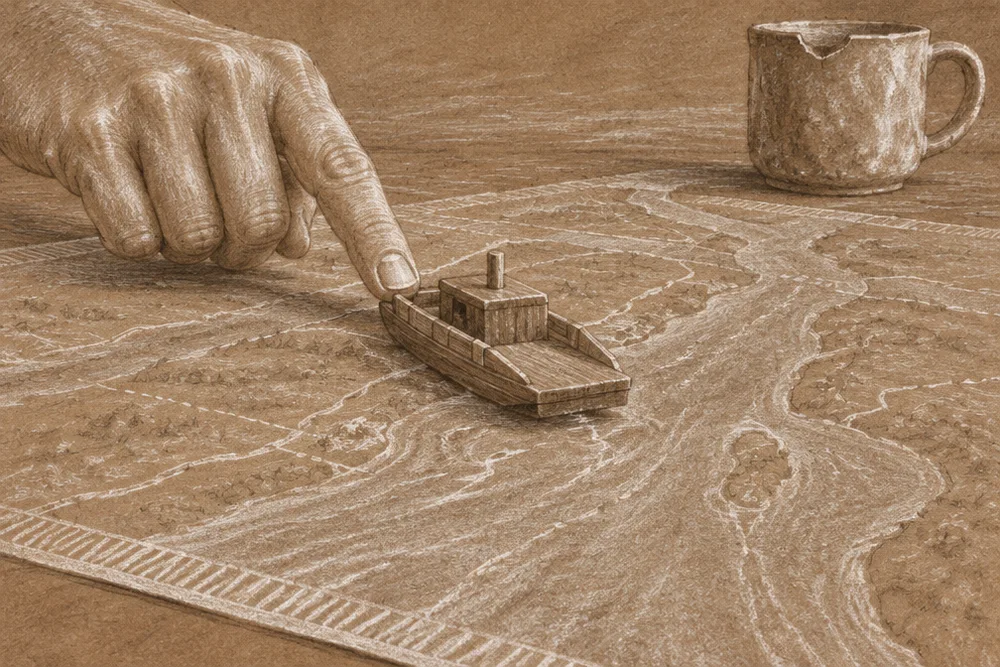
Ysolda unfolded the chart. The old official track ran in a straight blue line down the middle of the estuary. Her newer survey showed the same route in broken blue, with the submerged tollhouse ridge hatched red beside it. She weighted the corners with four chipped mugs. Then she placed the wooden ferry on the line and turned it so its blunt bow faced upriver.
“The flood tide sets this way,” she said, sliding the model with one finger. “The old causeway is under the channel. The tollhouse stood beside it. The roof is still there, or enough of it to strike a lead line. The modern sonar transect was laid through the middle. It missed the roof because the roof is outside that line.”