The Names Beneath the Soundings
Page 246 of 266
Chapters
Nia came to the wheelhouse after the last passenger stepped ashore. “She’ll make her appointment.”
“Good.”
“She still thinks you should have turned around.”
Ysolda looked at the water between the piles. “Did she say that?”
“Not in those words.” Nia’s mouth tightened. “It’s all right if she thinks it.”
“It is.”
Nia picked up her bag. The thermoses knocked together inside. “I’ll be on the return sailing.”
“You don’t have to.”
“I know.”
For the return, they carried only Nia, the examiner, and a sack of mail that had been waiting at the east landing. Ysolda checked the gauge again. The flood had strengthened, the surface wrinkled into narrow, slanting lines. She considered the crossing time, the wind, the ferry’s handling under the added set. The numbers still fitted the limits, but nearer the edge than before.
“We could hold here,” the deckhand said. He stood beside the mooring line, looking from the water to the gauge.
Ysolda checked the chart, then the river. “How long until the next check?”
“Ten minutes.”
The examiner made no sound. His clipboard rested against his chest. Nia leaned against a post, arms folded, eyes on the current. The sensible choice was not always the one that looked bold. A pilot who waited could be called timid; one who pushed a boat beyond its safe margin could make every other judgment irrelevant.
“We hold,” Ysolda said. “Ten minutes, then reassess.”
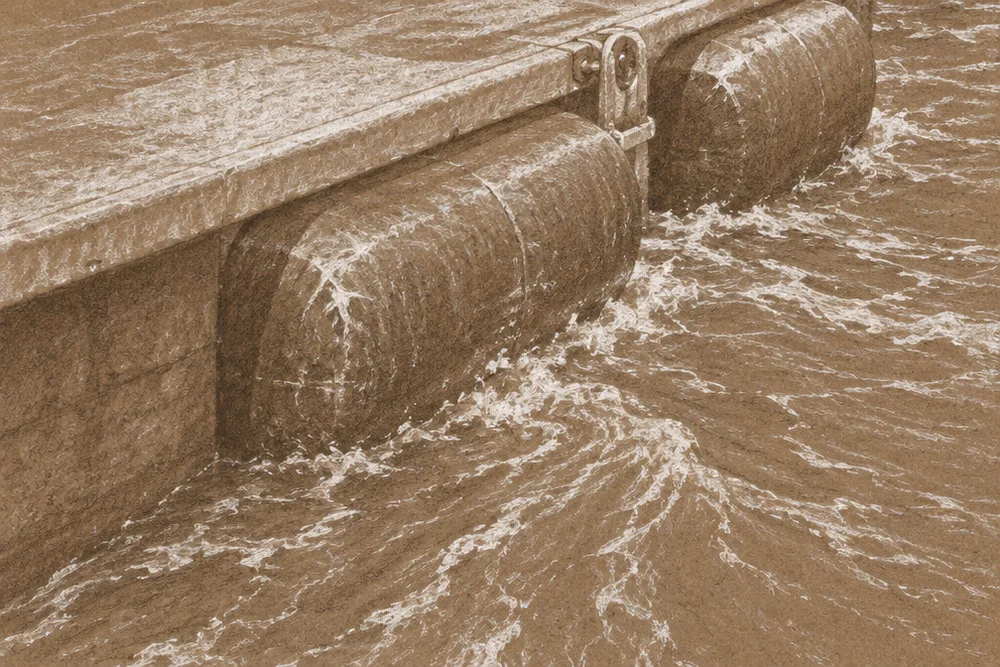
The deckhand secured the line. They waited while the flood shouldered the pontoon against its fenders. Across the river the west-bank yard remained visible, a low strip of roofs and gantries beyond the water. Ysolda could see the red flag above the exclusion mark. It hung nearly straight in the wind.
Nia came alongside the rail. “You’re allowed to say no.”
“That’s the job.”
“People will say the pilot’s berth depends on sailings.”
“It doesn’t depend on this one.” Ysolda checked the gauge. “And if it did, I’d still hold.”
Nia’s eyes searched her face. “I wish I’d heard that before.”
There was no useful answer. Ysolda’s mother had signed findings that called deaths accidents. Gethin had hidden readings. Bleddyn had offered a quiet route in exchange for silence, and then lost his authority over the yard. Everyone’s reasons had been made of smaller, ordinary things: a job, a promise, a fear of closing the crossing, the wish to keep a name from the papers. None had made the decisions harmless.