The Lake Has Office Hours
Page 177 of 276
Chapters
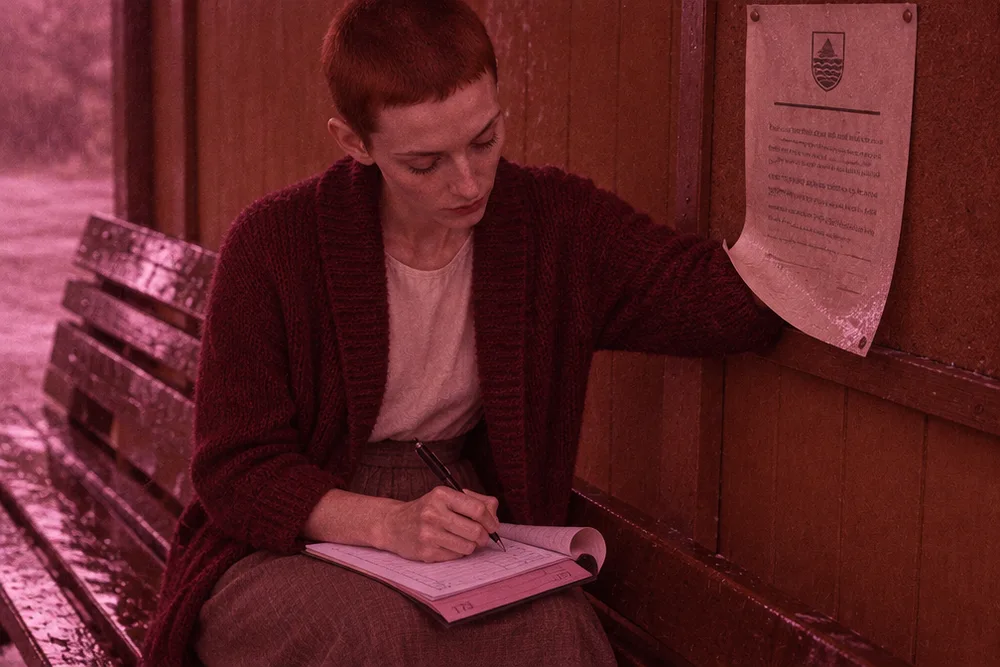
By ten, the porch had become a waiting room. People stood two deep under the narrow roof, leaving a strip of wet concrete between themselves and the steps. Tamsin worked at the bench with the receipt book across her knees, while the door behind her stayed propped open by a brass wastebasket.
She checked every submission against the intake screen before she wrote. The work was slow because the system wanted a parcel number, and people knew their homes by stair, shop, or landlord. One man gave her a description of the room where his daughter slept. Tamsin found his address by matching his landlord’s name to a rent-assistance attachment.
The receipt book filled with dates and times. The names came from different hands, some printed, some written in the long slopes of people unused to forms. A few residents had kept their rejected sheets in grocery bags; others had folded them into wallets until the creases split the paper.
“Why does it say acquired?” asked a gray-haired man named Harlan Voss. He had a carpenter’s pencil tucked behind one ear and a line of grit at his cuff.
“The parcel layer tells the intake program the property was acquired,” Tamsin said. “Then the program marks the address ineligible for an occupancy record.”
“But it wasn’t acquired.”
“I can’t change the map from here.”
“Can you change what it says we brought you?”
She looked at the receipt she had just written. “That I can certify.”
Harlan nodded, not satisfied but no longer asking her for something she could not do. He stepped aside for a young couple carrying a folder between them. One had a baby strapped to her chest beneath a raincoat. They gave Tamsin a utility bill, a lease addendum, and a form returned with its staple still in place.
Behind the glass, Verramont lifted the phone and spoke with his back to the porch. His hand covered the receiver. The closure notice fluttered above Tamsin’s shoulder, its lower edge coming loose from the board.
She finished the couple’s receipt, then braced the notice with her elbow while she pressed the carbon hard. The bench was slick beneath the receipt book. She kept one hand on the page and the other on the paper, preventing either from sliding.
“Next,” she said.
The queue shuffled forward. No one left. They had arrived to have their existence recorded, and now there was a witness to the date.
At eleven thirty, Verramont came outside. He carried a paper cup with its lid still on and held it as if he had forgotten why he’d brought it.