The Lake Has Office Hours
Chapter 11 · The Low Bid
Page 104 of 276
Chapters
Edric Verramont arrived at the clock shop in a raincoat too clean for the street. He stood heel-wide beneath the sign, his round face turned toward the upper windows and his pale lashes nearly invisible against the gray morning. Behind him, the slope climbed past shuttered houses to the school annex. Ahead, the road dipped toward the reservoir works. Maren could hear water tapping somewhere under the pavement.
“You asked to see the drainage alignment,” he said. “I thought it better to show you than exchange another set of letters.”
Maren wiped the oil from her fingers on her canvas apron. The shop smelled of brass filings, old wood, and the damp wool coats customers had hung by the door. On the counter lay the survey elevations Yale had brought her, their edges weighted with a clock movement she had not yet reassembled. “You said the demolition is a flood measure.”
“It is.” Verramont glanced at the papers. “And your numbers don’t change the fact that the street sits in the project corridor.”
“They change where the water comes from.”
A muscle moved beneath Verramont’s underbite. He had come prepared to be patient, Maren thought, which was not the same as being willing to listen. “Then let’s look at the works.”
She locked the shop. The deed dispute had made every errand feel like an act of neglect: leave the door, leave the clocks, leave the only place she had spent twelve years paying to own. She checked the latch twice, then followed Verramont downhill.
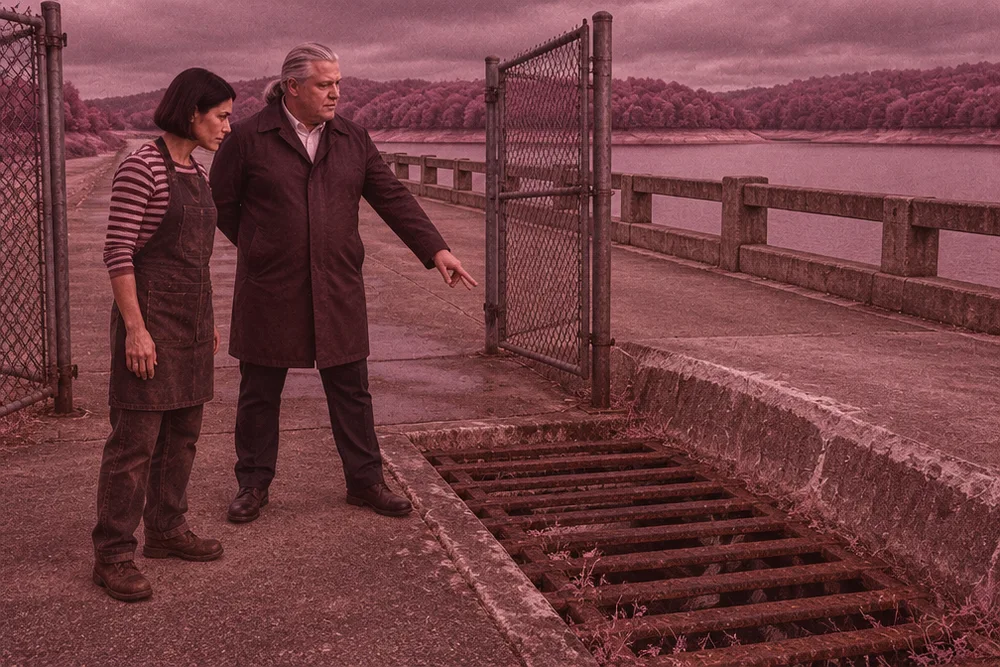
At the bottom, the reservoir road ran across a raised causeway. Beyond its concrete rail, the lake lay low and dull under the overcast sky. The surface was far below the street sill, nowhere near the level marked on the county’s flood map. A chain-link gate barred the maintenance road. Verramont produced a key and opened it.
“The lake isn’t the only water source,” he said as they entered. “That’s the part people keep missing.”
Maren looked at the black mouth of the gravity drain beneath the road. A rusted grate covered it. Weeds had grown through the lower slots, and a pale tideline marked the concrete on the uphill side. She leaned ear-first toward the opening. A faint, irregular plunk came from inside.
“This is the main outlet?” she asked.
“It was designed to carry uphill runoff under the causeway and away from the low street.” Verramont pointed with two fingers, careful not to touch the grate. “The lake stays on the other side. Gravity does the work, when the line is clear.”
“When?”
“The outlet is obstructed.”