The Lake Has Office Hours
Page 167 of 276
Chapters
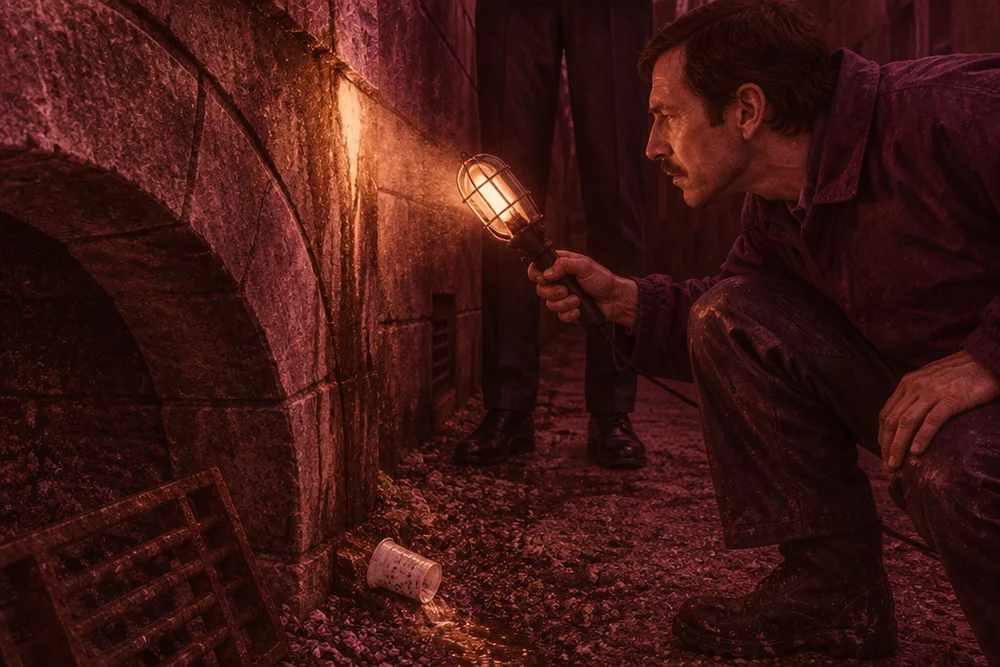
They reached the alley behind the shop. The entrance was half-hidden by a leaning fence and a pile of branches left by the flood. Lorne pushed through first, turning sideways between the fence and the wall. Yale followed, his shoulder brushing splintered boards. The alley smelled of wet stone, leaf rot, and the mineral cold of standing water.
The old drain began beneath a shallow arch of fitted blocks. A rusted iron grate lay on its side nearby. Beyond the arch, the channel narrowed into darkness. Lorne crouched to shine a work light along the floor. The beam found a shallow stream threading between gravel and a white plastic cup.
“That’s runoff from the upper steps,” he said. “It should be moving away from the street.”
“But it isn’t.”
“Not with the lower section blocked. Water rises here and finds whatever opening it can.” Lorne turned the light to the wall. A brown line stained the stone above Yale’s knee. Higher up, muddy streaks fanned toward a cellar vent. “This is where it backed out.”
Yale leaned close, ear-first, though there was nothing to hear but the little trickle and the distant clank of a crew unloading equipment. The mark climbed from the channel, not from the lake. He had seen the same evidence in the shop, in the old high-water line Maren had found. He had known it was possible. He had not known whether the evidence could support a different conclusion.
“The county’s incident summary says lake water overtopped the low street,” Yale said.
“The lake didn’t reach that sill,” Lorne replied. “I checked the gauge.”
“The summary was based on a field return.”
“Then the field return was wrong.” Lorne did not soften it. “I can tell you what the marks say. I can’t tell you who decided to describe them differently.”
Yale straightened. His hips complained. “I signed the vacancy certification. I did not write the incident summary.”
“I didn’t ask who wrote it.”
They stood in the narrow alley while the light trembled in Lorne’s hand. Yale could feel the old impulse to divide the work into pieces: his signature, someone else’s report, a county map filed in one drawer, the construction plan in another. His name was on the first piece. That was enough to make every other piece look like an excuse.
Lorne pointed to a seam in the masonry. “The bypass could follow this route to the street, then turn under the shop. We’d have to remove the lower floor and the rear wall. The inlet would occupy most of the footprint.”