Six Eggs and a Share in the Ferry
Page 21 of 251
Chapters
She carried the papers indoors and placed them in the drawer. The house award had not grown. The ferry might make the difference between a key in her pocket and an apology to Mr. Bell. She was not prepared to give up that possibility on a suspicion alone.
Edwin worsened in the second week. He could still sit up, but only when Agnes helped him shift forward in the cane chair. His plum vest hung loose at the shoulders, and his cheeks had hollowed further. He ate little. The doctor came once, listened to his chest, and spoke with Agnes in the passage rather than in front of him.
“He may rally,” the doctor said. “But you should make arrangements.”
“What arrangements?”
“The ones a daughter ought to make when her father is failing.”
Agnes had already made the arrangements she could bear to name: water near the chair, a clean shirt, the bed turned down early. She said nothing. The doctor touched the brim of his hat and left.
That afternoon Edwin called her from the window. “The book.”
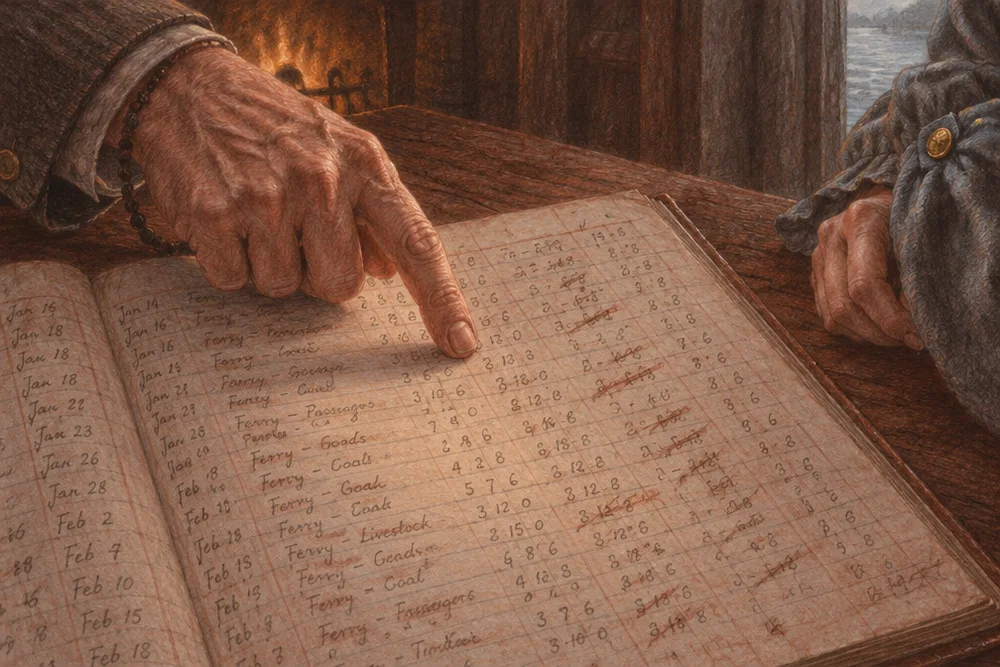
She brought the ferry ledger from the drawer and sat at the table. He pointed to a page with his bead hand. The entries there were crowded, numbers squeezed between dates and scratched over in places.
“That winter,” he said. “The payment came in then.”
“How much?”
“Not all at once.”
“Who paid?”
He stared at the page. “There were people. They knew the service had to keep going.”
“Did you promise them anything?”
His eyes lifted to her face. For a moment they were clear and quite awake. “I promised the ferry would run.”
“In return for their money?”
“In return for keeping it.”
“Keeping what?”
He shifted, uneasy. “The crossing. The rope. What needed doing.”
Agnes waited. He put a finger to the page, but his hand trembled and the mark wandered over two lines. “There’s the money,” he said. “Some of it. Winter payments.”
She studied the ledger. The entries were not enough to identify anyone. A figure had been written beside a date and then repeated under another heading. On the next page, repair costs appeared, followed by fares. It was possible to read them as one household’s contribution, or as a general sum. She could not make them mean what he wanted them to mean.
“I’ll find the papers,” he said.
“What papers?”
“The notice.”
“Where is it?”
But his focus had already gone. He turned his head toward the water, and the book lay open between them, its columns unhelpfully full.