Six Eggs and a Share in the Ferry
Chapter 14 · Chairs Off the Scale
Page 166 of 251
Chapters
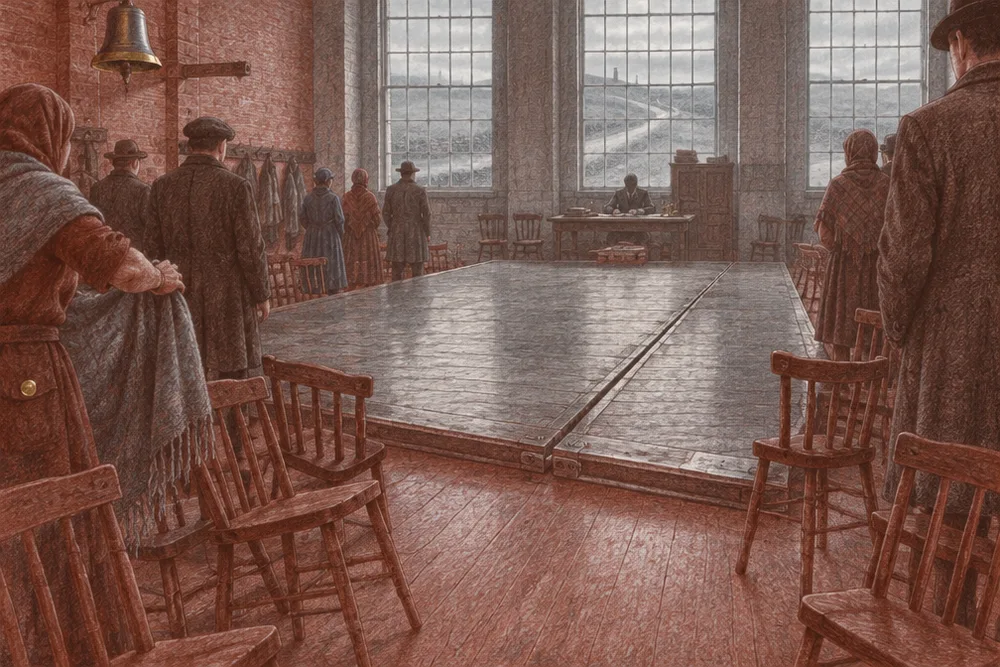
The clerk asked the tenants to stand clear of the scale platform, and the first row of chairs scraped backward in a single ragged sound. Agnes watched a woman catch her shawl before it slid to the floor. The old wool-weighing room smelled of damp stone, ink, and wet coats. Beyond its high windows, the upland road ran pale against the April-gray sky; below it, unseen from here, the beck kept moving toward the works that would stop it.
“Not there, if you please,” the clerk said, pointing to the platform. “The witnesses are to stand upon it. The furniture must be clear.”
The chairs had been arranged by the board’s porter in two neat ranks: freeholders close to the chairman’s table, tenants behind them. Now the reserved front row had broken apart. A chair bumped the clerk’s table, which straddled the seam in the floor where the old scale had been fitted. One leg rocked. The clerk put his palm on a stack of papers to steady them.
Agnes folded her cuffs twice, though they were already folded. She stood beside Martha Rigg, whose yellowed wrist wraps showed beneath her striped apron. Martha’s feet were set apart, one forward, braced as if the floor might tilt. Silas Prowse waited near the stair, short and broad through the chest, his collarless coat buttoned wrong at the throat. He had the brass thimble he used for mending in his pocket, and kept his hands folded over it.
“Owners first,” said the porter, trying to restore the rows. “Then the other claimants.”
“We have all come about the same undertaking,” Agnes said.
The clerk looked up. “That is what the hearing is to decide, Mrs. Venn.”
She saw the board chairman lay his slate gloves flat before him. Dacre’s narrow coat sloped at the shoulders; his clipped sandy whiskers made his mouth appear even thinner. He had the look of a man who had already counted the minutes left to him. Agnes understood that the scattered chairs were not the matter. Still, she could not stop looking at them: the people who had been placed behind, now standing in the same untidy space.
The clerk called the land claims first. Each witness stepped onto the platform, gave a name, and answered questions about walls, roofs, gardens, and outbuildings. Agnes listened to the measured sums, the clerk’s nib scratching, the small pauses before Dacre said accepted or referred. Her own house had already been valued. The kitchen bench, fixed beneath the window, appeared in the inventory as a fixture; the appraiser had not asked why ferry callers sat there to wait out rain.