Six Eggs and a Share in the Ferry
Page 208 of 251
Chapters
“I’ll write it as you say,” Nell answered. She had brought a small notebook for receipts, its cover softened at the corners. “If the place is unused, I won’t carry its fare forward without asking.”
“And don’t put it in your tally as a regular rider,” Agnes said.
Martha’s eyes narrowed slightly. “You have remembered.”
“I had started to count it that way.” Agnes drew a line through her own note. “I won’t do it again.”
The correction cost only ink, but it left the paper cleaner. Martha had not asked Agnes to manage the fund, nor Nell to promise a seat every week whether or not a washer needed one. They had agreed to buy an option, not surrender the choice of using it. Agnes felt the plainness of that arrangement settle into her thoughts. It was less secure than a full route guaranteed by a great sum. It was also something the people who would ride could control.
Nell shut the notebook. “Four weeks. The money for each week in hand before I go. If it doesn’t meet the minimum, I don’t climb the road for nothing.”
“That is what we’ve agreed,” Martha said. “Not more, and not less.”
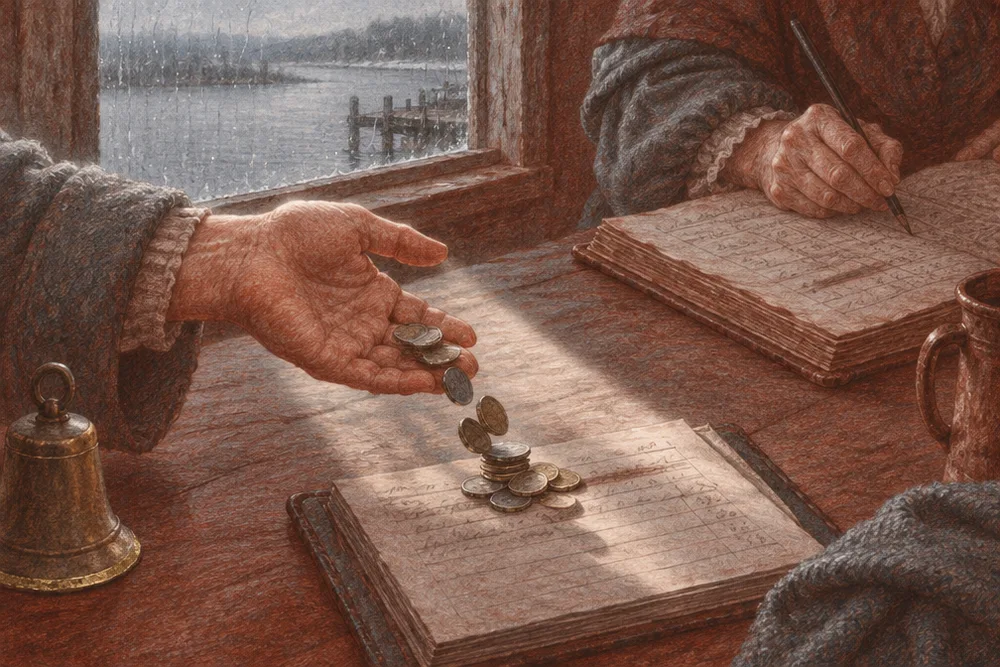
After Nell left to check the wagon, Agnes sat with Martha and listened to the rain ticking against the window that looked down toward the old landing. There was no ferry bell there now to tell people when a crossing was ready. The river had begun to look less like a road and more like a boundary, though the reservoir had not yet swallowed the village.
“Some of them will use the money for things you won’t see,” Martha said. “That’s how it ought to be. A payment isn’t an order to ride.”
“I thought if the loop connected Burr Lane and Sedge End, they would all want it.”
“Wanting isn’t the same as being able to afford it.” Martha tugged one wrist wrap into place. “And being able to afford it isn’t the same as needing it every week. I’ve work to get done, and I can’t leave a wash on the line because a wagon has a seat for me.”
Agnes folded the cuffs of her blouse twice, the movement so practiced she only noticed when the cloth pressed against her wrists. She had hoped the route might knit the scattered households back together. She could see now that the route could do no such thing if it asked each person to arrange a life around it.
“What do you want it to do?” she asked.