Six Eggs and a Share in the Ferry
Page 118 of 251
Chapters
Back at the road, Nell had already marked the gate in her notebook. “I can stop there, not below. I’ll wait five minutes, no more, or I lose the mill turn.” The woman nodded. “Five is honest.” She sounded neither grateful nor pleased, which Agnes thought was fair. A service that asked for trust had to be exact about what it could not do.
The route went on to Sedge End. They reached it later than the paper promised. The last rider was not waiting at the road. A young woman’s brother stood by the gate with a small parcel and a face set against being questioned.
“She’s gone to the mill,” he said. “Couldn’t lose her shift.” He had come to tell them she would not be riding. There was no complaint in his manner, only the fact of a clock that did not wait for the wagon.
Agnes looked at the sun through the thin cloud. The mill bell would already have sounded. “When did she leave?” “Before the hour you gave us.” He shifted the parcel from one hand to the other. “She said she’d rather walk than be docked pay.” Nell’s jaw tightened. The route had been arranged around passengers who could afford to wait. A woman paid by the hour could not make use of a bargain whose chief cost was time.
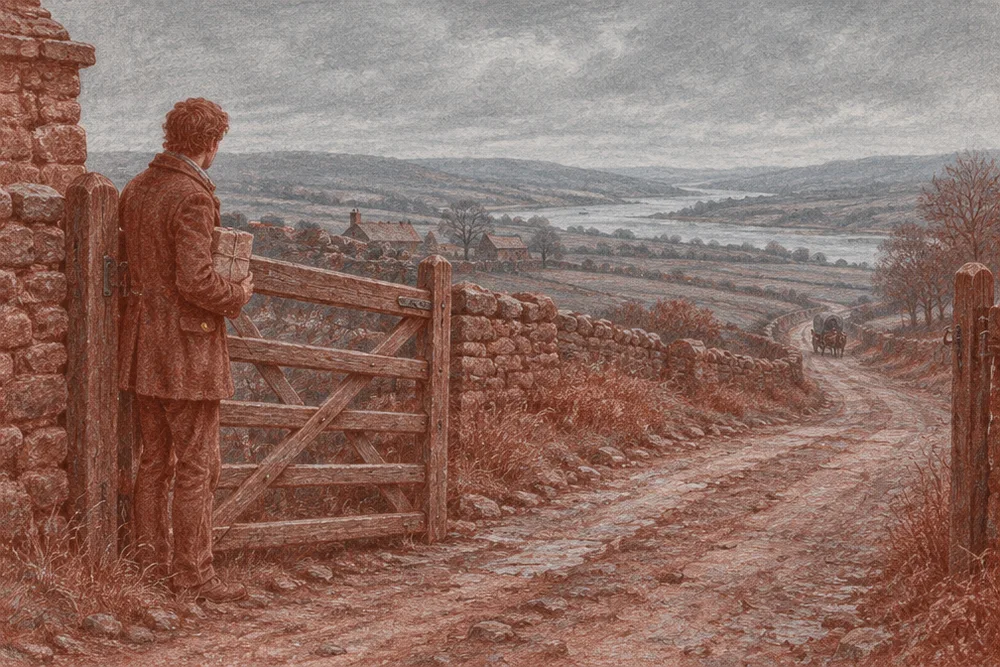
Nell got down from the bench and examined the road beyond the gate. “I can’t bring the wagon here earlier and still take the Burr Lane stop,” she said. “Not with that hill. If I cut the hill out, I leave the mother’s place out too.”
“She can come to the upper gate,” Agnes said, then stopped herself. The woman’s brother had heard enough to look toward the cottages, not at Agnes. “That’s not the same as reaching her door.”
“No,” Nell said. “And I won’t write it as if it is.” She checked the time against a small watch, thumb covering its face while she counted. The mill gate was still reachable, but only if Sedge End came before Burr Lane. That would put the wagon on the steep grade with a fuller load. If they went to the mill gate after the settlements, the workers would already be inside. Every order of stops cost someone something.