Park the Buses for a Blackbird
Page 8 of 214
Chapters
She listened to the section a third time, this time without looking at the meters. A radio answered in the background, indistinct. The woman did not explain where her daughter was going or why the bird mattered. She asked for ninety seconds. That was all.
The recording continued. A chair creaked. Someone said, “All right,” as if agreeing to move a bus schedule by a fraction. Then there was a burst of static and the rehearsal resumed.
Vera opened a new file and entered the timecode. She did not mark the voice as the approved excerpt. She gave the file a plain name: end_request_uncut.
Her work computer displayed a warning that the new copy was not part of the scheduled broadcast package. Vera clicked preserve source, then checked the destination twice. She could hear the city outside Slip House, buses climbing the narrow shopping streets toward the broad former freight apron.
For a moment she thought of the ticket stamper’s operator asking who would hear it. The answer was no longer simple. Someone would hear this recording if Vera made it possible. Someone might hear more than the woman had meant to give.
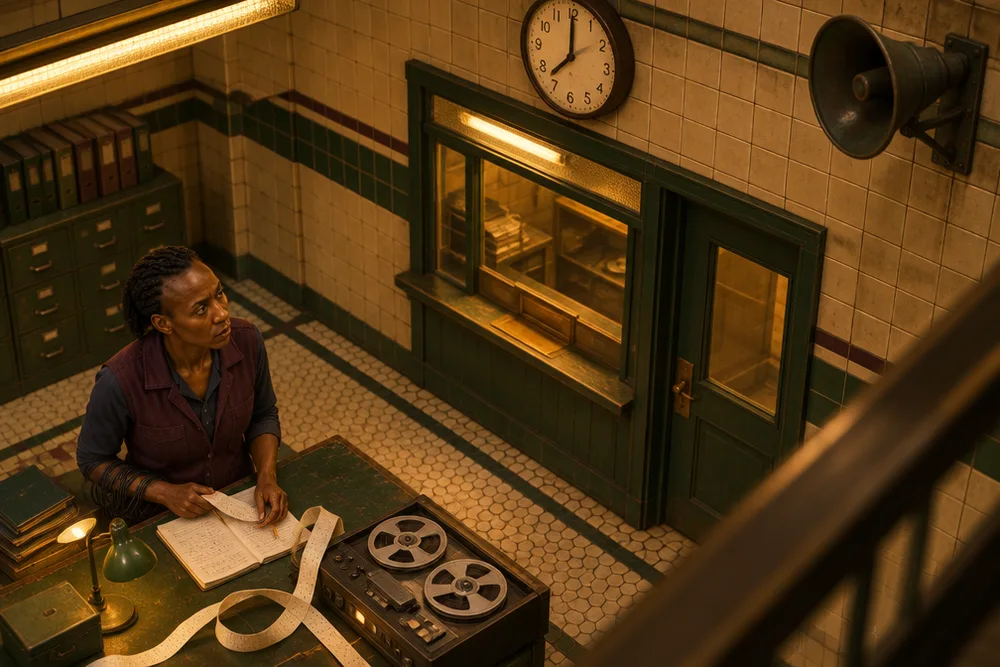
She took off her headphones and set them carefully beside the deck. Her left temple, bare beneath her close twists, felt cool where the foam had rested. The room’s fluorescent hum came back in pieces.
The tape could be a rehearsal unrelated to the annual stop. A woman could have asked for an engine break on any Saturday. The card could be wrong, or incomplete, or built from a version of the story whose evidence had been lost. A request on a tape was not a date, and a voice was not permission.
Vera wrote each possibility in her notes, though she knew the list could not protect her from choosing. She had promised Ned a restored excerpt. She had also promised herself a full-year archive that would not turn the city’s ordinary sounds into anonymous property.
She rewound to the first slate and listened for a route number, a place, anything that could anchor the voice to a year. The tape gave her a dispatch call sign and a rough sequence of checks. The year remained uncertain.
The clock above the door advanced by a minute. On the other side of the room, the old street speaker sat silent in its bracket. It had once announced departures to people waiting outside. The ticket office had become an audio room, but the equipment seemed to remember what it had been asked to do.