Park the Buses for a Blackbird
Chapter 3 · The Ledger Closes on Saturday
Page 21 of 214
Chapters
The customer set a cracked hubcap on the counter and asked Celia whether the Saturday memorial had been named for her. He said it with the careful brightness people used when they thought they had found a tender fact: the girl on the bus, the mother who’d made the city stop, the daughter who had grown into the woman keeping the books above Latcher Tire.
Celia was totaling a supplier’s invoice. She kept her pencil on the column. “It wasn’t named for me.”
“But you’re Celia Dacre.”
“I am.”
The man shifted the hubcap against his thigh. Beyond the counter, a compressor kicked on in the nearer bay, rattling the loose pane above the air hose. Orren Latcher called for a fourteen-millimeter socket. Celia entered the invoice total, checked the decimal, then looked up.
“There wasn’t a memorial when I left,” she said. “My mother asked some drivers for a favor. Later, people added the solemn parts.”
The customer blinked, not quite embarrassed, not quite ready to give up the story. “Well, it’s a lovely tribute.”
“It may be. It isn’t what she asked for.”
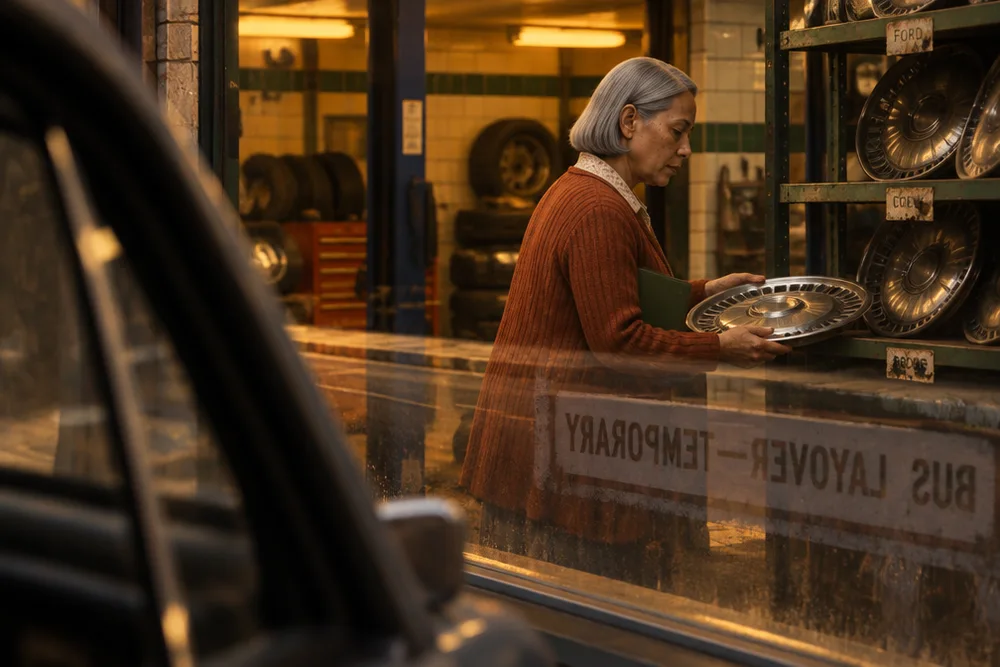
He paid for the hubcap and left it on the counter while he went to find his car. Celia carried it to the shelf under the window, where the labels had begun to peel in the damp. From the street, the shop glass reflected her cardigan over the faded lettering on the opposite curb: BUS LAYOVER—TEMPORARY. The sign had been there long enough for grime to make a border around it.
Upstairs, her green ledger lay open beside the kettle. Its bent corner held the page where she kept the dates of deliveries, late rents, and repairs Orren said he’d remember. She set the supplier invoice under a paperweight. A new appointment card had been tucked beneath the ledger’s cover, left by a municipal technician who had called ahead.
The card said Vera Tern, Municipal Sound, and gave a number. Celia had not called it. She had told the person on the phone that she did not do interviews.
Orren appeared in the doorway wiping his hands on a rag. “That customer ask you about the buses?”
“He asked if my mother named the memorial after me.”
“Did she?”
“No.”
He gave a small grunt that might have meant he believed her or that the question was none of his business. Orren valued the forecourt’s clean turning arc, the rent paid on time, and the reputation he had acquired for lending the curb. He kept all three carefully separate.
“The city woman’s coming,” Celia said. “The sound technician.”
“You told her not to.”
“I told the office I don’t do interviews.”