Park the Buses for a Blackbird
Chapter 18 · The Smaller Number Passes
Page 184 of 214
Chapters
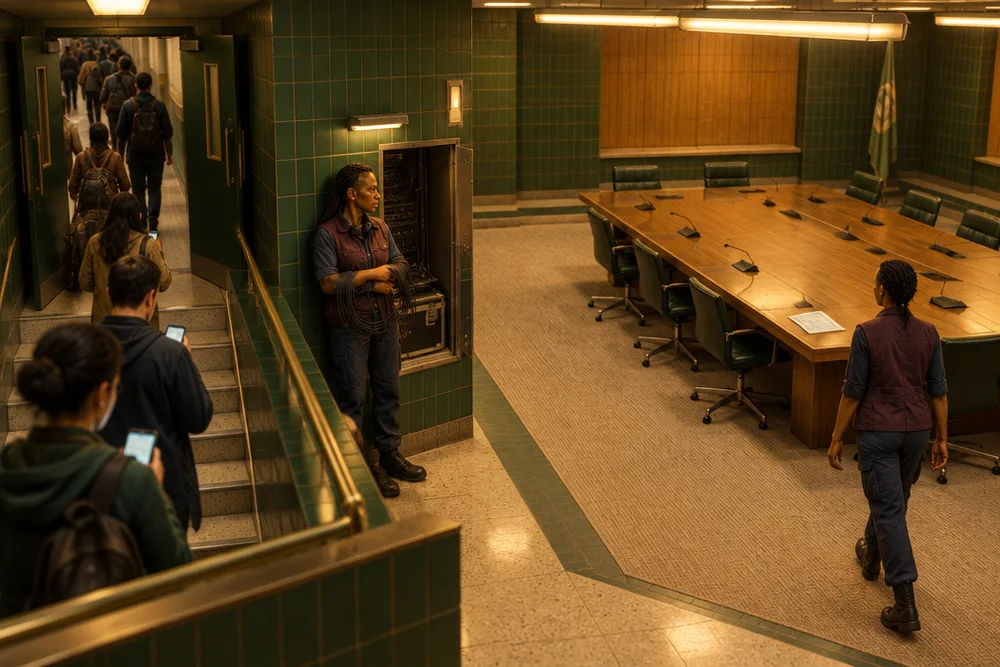
The gallery doors opened before the last stopped bus had cleared the public feed. People came down the narrow stair in a compressed, careful stream, some still looking at their phones as if the ninety seconds might have left a mark there. Vera stood beside the equipment hatch with her headset around her neck. Across the Chamber Annex, the council’s long table waited under honey-colored fluorescent light. On it lay the approved broadcast card, faceup, its generic tribute printed in Ned Pallis’s neat blue annotations.
“You should have waited until the feed was over,” Ned said. He folded forward at the hips, shiny cuffs catching the light. “You took a civic observance and made it a correction.”
“The feed was over,” Vera said. Her voice sounded thinner than it had through the microphone. “The engines were off. I used eleven seconds.”
“You used public airtime to introduce an unverified account.”
“I didn’t play the tape. I didn’t name anyone. I said there was no disaster.”
At the gallery rail, a woman in a depot uniform turned toward them. Suri Bale had come in from the apron with her mustard shell still zipped and her white grease pencil behind one ear. “The stop was safe,” she said. “Nobody was asked to hold an extra second. That’s what I can verify.”
Ned’s narrow mouth tightened. “We are not voting on the stop.”
“No,” Vera said. “We’re voting on what happens to the recordings.”
The first speaker at the public microphone was Councilor May Venn, who had supported the citywide appropriation through committee. She did not sit. “I voted for the full archive because the city promised a shared record, available to everybody. This afternoon the technician used the city’s loudest channel to make a private history into public fact. I have concerns about both parts.”
A man near the aisle muttered that the history had been public for years. May looked toward him, then back to Vera. “A story repeated is not the same as consent.”
Ned nodded once, as if she had supplied the useful half of his argument. “That is precisely why we should preserve the established wording. It has been vetted. It keeps the ceremony from becoming a dispute about one person.”
“It already became a dispute about one person,” Vera said. “That was the problem with the old wording.”
“You can’t know how many people heard what you said as an accusation.”
“I said the old claim was wrong. I didn’t accuse anybody.”
The council chair tapped her pencil against the agenda. “Ms. Tern, you will have time to answer when the proposal is before us.”