Park the Buses for a Blackbird
Page 44 of 214
Chapters
“Two buses can sit nose to tail if the first one comes far enough down,” she said. “A third puts its back end across the turn.”
Orren nudged a loose pebble with his shoe. “And a truck comes when it comes. You can’t tell a driver to come on Tuesday because the city wants a picture.”
Celia extended the chalk arc until it crossed the proposed third-bus mark. “Let’s see whether they can fit it anyway.”
They borrowed three battered shop stools and set them along the chalked bus positions, each one just wide enough to stand in for a vehicle’s rear corner. Orren took the driver’s place at the street, hands on an imaginary wheel. Celia walked the delivery route from the curb, carrying a crate of old wheel weights to give her steps the truck’s burden.
At the first stool she had room to pass. At the second she turned sideways, one shoulder brushing the wall. The third blocked the turn completely. The crate bumped the stool and tipped; small iron weights spilled across the concrete with a hard clatter.
A customer at the open bay looked up from his phone. “That’s the route they’re doing?”
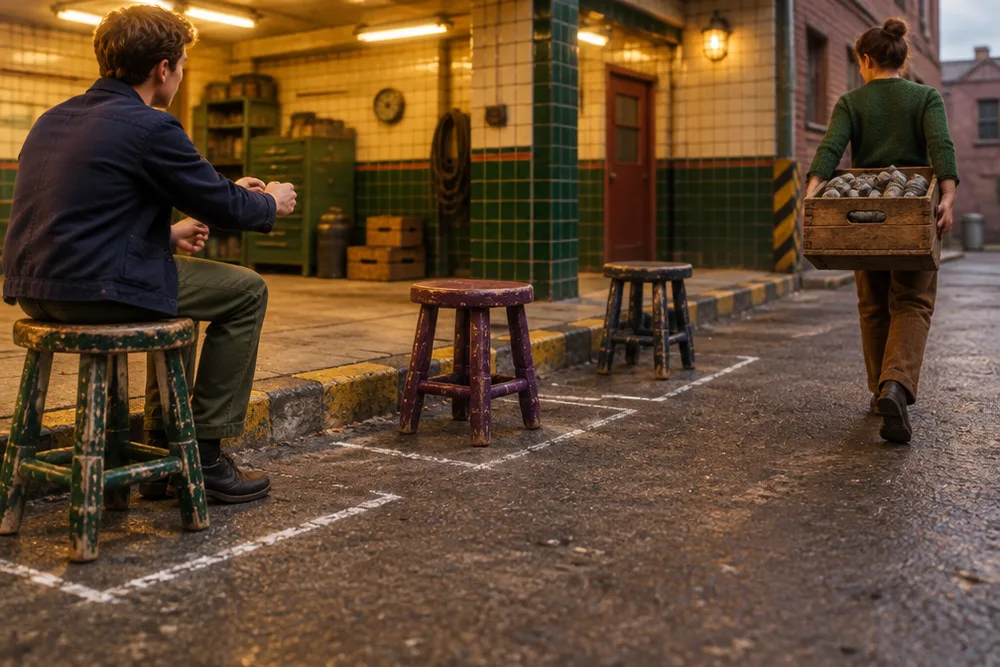
“That’s what they’ve drawn,” Celia said, gathering weights. “We’re checking the drawing.”
Orren moved the third stool half a foot toward the street. The crate still wouldn’t clear without crossing the neighboring shop’s threshold. He moved it back, then turned his hands palm-up. “There. A truck cannot deliver here while your three buses are parked.”
The customer stooped to help collect the weights. “But it’s just once a year, isn’t it?”
“The truck doesn’t know that,” Orren said. He was less sharp than Celia expected; the man had bought tires here for years. “And the people waiting for a delivery don’t either.”
Celia dusted grit from her fingers. The route map had made the forecourt look like a free, blank patch of public ground. In chalk and stools it became the shop entrance, the turning space, and the only way the Saturday delivery could reach them.
The next morning Celia carried the map and the chalk measurements to the dispatch office at Mains Depot. The building rose behind the former freight apron, its glazed service pits bright under the loft windows. Diesel and warm dust hung in the air. Drivers crossed the apron with travel mugs and clipboards, and a cleaner steered a mop bucket around the painted lane marks.