Name Your Boat, Cut Your Sail
Chapter 17 · The Stair Comes Down First
Page 211 of 258
Chapters
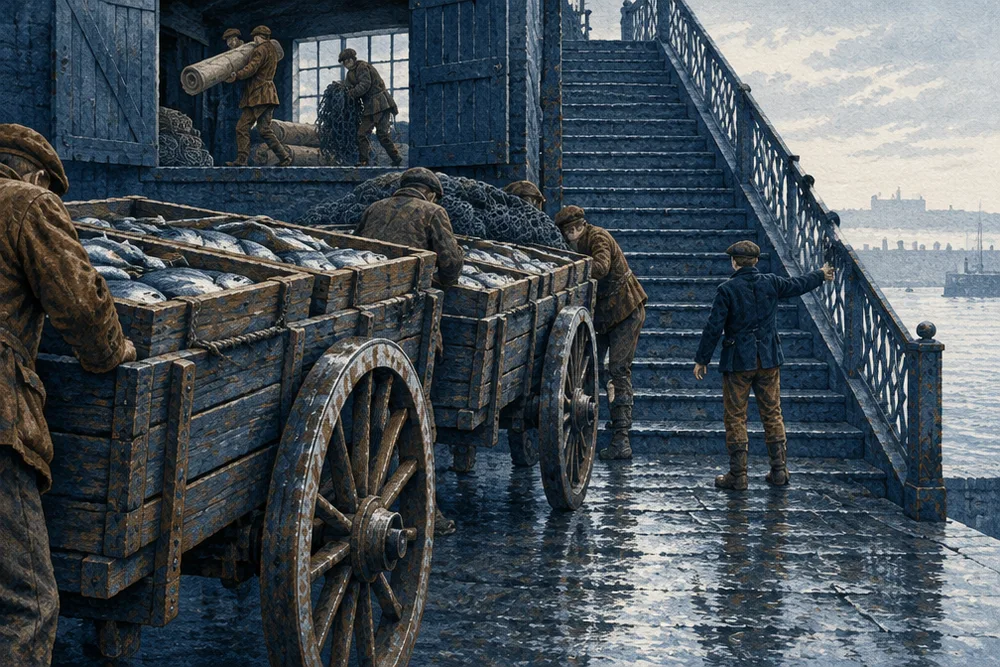
By the time Edwin reached the landing, the first fish cart was already waiting at the turn. The tide had left a narrow strip of wet stone between its wheels and the iron stair. Above it, the loft stood open to the grey morning, the door propped wide for the last removals. Men were carrying out canvas rolls and bundles of netting. The demolition crew had said they would begin with the stair as soon as the floor was clear. Nobody had said how long it would take to clear it.
Edwin set his watch, though he knew the hands were right. The watch chain looped twice across his narrow waistcoat, and the cold had made the metal bite through the cloth. He leaned forward from the neck to look along the quay. Two council carts waited at the upper end of the lane, their drivers holding the reins short while fish porters crossed between them. A third cart had not arrived. If the landing clogged, the fish carts would be held against the wall and every delay would be laid at the feet of the people whose work had already been denied in the cooperative book.
“Not there,” he told a porter who was about to set down a coil beside the stair. “That’s the cart turn.” The man paused, sweat shining at his temples. “Then find us a place to put it.” Edwin glanced up toward the open loft. “I’m trying.”
He had been given no authority to direct the removal. He had volunteered to make a schedule, and Mara had said that was useful, which was not the same thing. At the hearing, the council had recorded the menders as displaced traders and allowed carts for their gear. Edwin had spent the previous evening with a stub pencil, a strip of wrapping paper, and the names each woman had given him. The names went on the bundles, not the boat accounts. He had been careful about that distinction.
His first list put the dry canvas and sailmaking tools on the first cart, the smaller nets on the second, and the racks last. He had left space for the fish landing at each hour and marked the expected tide beside the times. The drivers had looked at him as though he were making more of a simple job than it needed. Then the first cart had arrived too early, and the second too late, and Edwin had been grateful for every line he had written.