Name Your Boat, Cut Your Sail
Chapter 12 · The Wrong End of the Bench
Page 146 of 258
Chapters
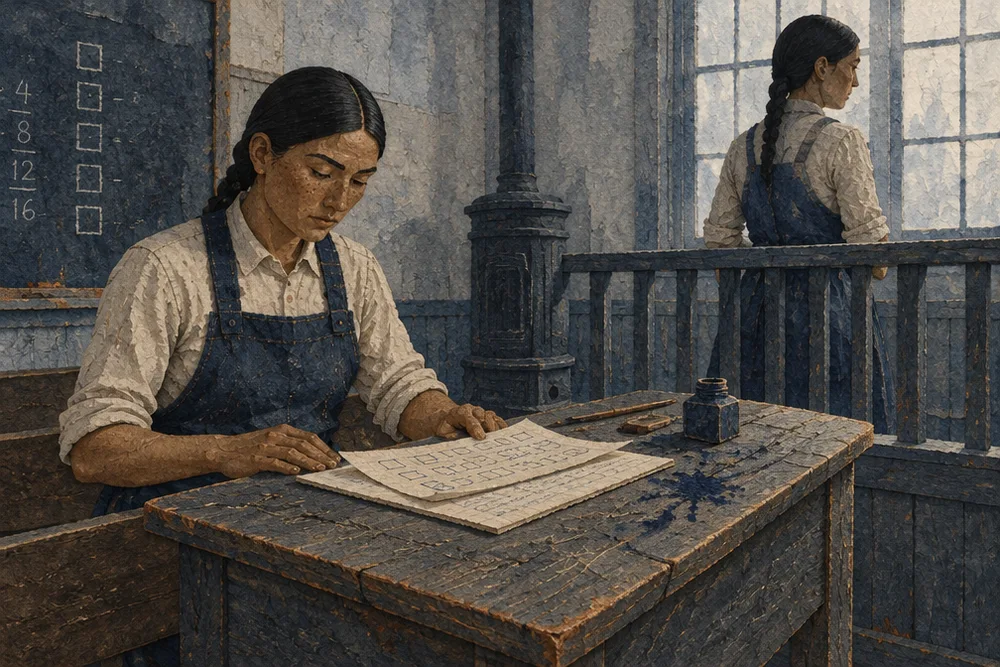
Edwin’s statement arrived at the washing yard folded into a square and passed from hand to hand without being read aloud. Nell watched Mara open it beneath the line of shirts, where the afternoon wind kept lifting the corners. The paper said what Edwin had done at the cooperative: weighed fish, sorted envelopes, returned unclaimed money. It said the headings in the book named boats and husbands, not the women who had mended the nets. It did not name any woman. At the bottom Edwin had signed his own name in a careful hand.
“He’s put his wages behind it,” Bess said. She had come straight from a boat, her blue patch dark with damp where her skirt brushed the net she carried. “They can take his Saturday shift. They can’t take mine. Mine’s already spent.”
Mara looked at Nell. “You said he’d write what he saw, not what we ought to do.”
“That is what he wrote.” Nell held her hands still at her sides. The old impulse was to gather every paper, arrange every fact, and carry the case to the Tin School as if it were a sail pattern she alone could lay out. She had spent weeks telling herself she was only making room for other people’s words. The bench in the hearing room was still in her mind: a high place from which the clerk could see her and the gallery could not easily interrupt.
Mara folded Edwin’s statement again. “We’ll decide what it’s for.”
They met two days later in the Tin School, while the council clerk was away and the room smelled of chalk and cold stove ash. Nell took the bench at the front. The narrow teacher’s desk stood beside her, ink-stained and scarred by compass points. She set Edwin’s statement on it, then placed a sheet of her own notes beneath the paper.
“The first question will be whether the cooperative’s books show women’s work,” she said. “I’ll explain that the books recorded boat accounts, not individual hands. Then I’ll give Mara’s rate and the dates—”
“You’ll give mine?” Mara asked from the gallery bench.
Nell stopped. “If you want me to.”
“I haven’t told you my rate.”
“You did, when we went through the old repairs.”
“I gave it to you for your estimate. That was paid work. It wasn’t permission to put it in the council record.”
Nell felt the heat come to her face. She glanced down at her notes. She had written the rate in the margin, in the same square figures she used for canvas measurements. Seeing it there, she understood how easily a number could look like a fact that belonged to whoever had copied it.